




The Evolution of Authority
 When I founded Stellar SEO, search was dominated by a single conversation: how many backlinks you could acquire and how much authority those links carried. That era is over.
Today, authority is defined by how consistently a brand is recognized across search engines and AI systems as the source of truth for a specific topic and location. Link building has evolved into something more precise. We are shaping the data signals that search engines and Large Language Models rely on to understand who should be trusted.
This glossary reflects that change and introduces the vocabulary required to move from mechanical SEO tactics to true Entity Validation. These concepts guide how we help clients move beyond rankings and become the answer that systems like Google and modern AI platforms select.
I invite you to explore these terms and understand how authority is built in today’s search environment.
Travis Bliffen
CEO, Stellar SEO
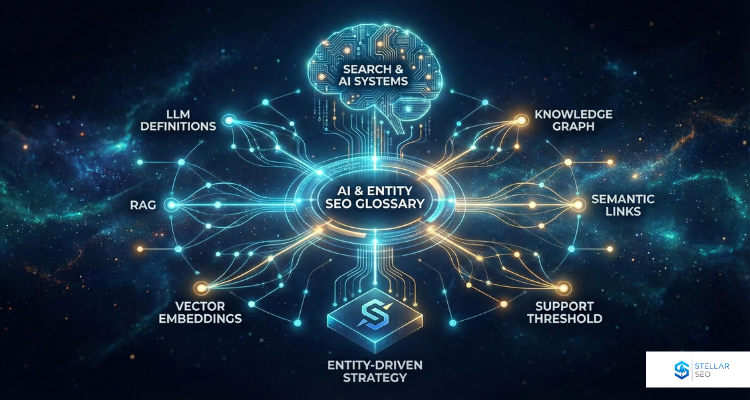
AI & Entity SEO Glossary with Internal Links
- AEO (Answer Engine Optimization): This is the process of structuring content so AI systems can extract it as a direct answer. It involves using clear headings and self-contained paragraphs.
- AI Visibility: A metric that tracks how often a brand appears in AI-generated summaries. It also measures how often a brand is cited as a source. Our AI SEO services focus on increasing this specific footprint.
- Branded Search Growth: An increase in users searching for your specific firm or brand name. This serves as a primary signal to search engines that your brand is gaining real-world popularity. It is closely tied to brand mentions and unlinked mentions.
- Co-occurrence: The frequency with which your brand name and specific keywords appear together in the same content. This helps AI models learn that your brand is related to specific topics. This is a foundational element of semantic link building.
- E-E-A-T (Experience, Expertise, Authoritativeness, Trustworthiness): This is the framework used by Google to evaluate content quality. Search engines prioritize evidence of real-world involvement. Learn more about building authoritative content that readers trust.
- Entity Validation: This is the process where a search engine confirms a brand is a trusted authority in a specific niche. It requires consistent mentions and links. Our entity-driven link building system is designed to trigger this confirmation.
- GEO (Generative Engine Optimization): A strategy focused on making content more citeable for generative AI models. It involves providing unique data and expert quotes. This is a core part of our AI SEO services.
- Information Gain: This measures how much new, unique information a page provides compared to existing search results. Search engines now prioritize unique value. See our full guide on what information gain is in SEO.
- Knowledge Graph: A massive database used by search engines to understand relationships between people, places, and things. Link velocity helps place your firm into a specific node. For deep dives, see our articles on the Google Knowledge Graph and how to map your entity clusters.
- Lexical Alignment: This happens when the vocabulary in your content and links matches the technical language of your industry. It is a critical component of semantic link building.
- LLMO (Large Language Model Optimization): The practice of ensuring AI models accurately represent your brand. This requires writing LLM-optimized content that models can easily ingest and recall.
- RAG (Retrieval-Augmented Generation): A process where an AI model searches the live web for fresh information before generating an answer. Maintaining healthy link velocity ensures your brand is retrieved during this process.
- Semantic Event: The moment a new link or mention appears in a contextually relevant environment. It acts as a tag that defines your brand entity. This concept is explored further in our semantic link building guide.
- Support Threshold: The level of brand activity required to justify a specific rate of link growth. If link velocity exceeds this threshold without supporting signals, growth may appear artificial.
- Vector Embeddings: Numerical representations of your brand’s meaning. AI models use these to map how close your firm is to a topic. We explain this in detail in our guide on how Google really ranks sites in 2026.
- Zero-Click Result: A search result where the user finds the answer directly in a snippet or AI summary. While users may not click through, your brand gains authority through the citation. This is a primary goal of unified entity domination.
Moving Beyond the Basics
The concepts defined here describe how authority is actually evaluated in modern search and AI systems. As content production accelerates, the signal that matters is recognition. Who is mentioned, who is cited, and who is consistently associated with specific topics and locations.
At Stellar SEO, we focus on how those signals are formed and reinforced. We track Support Thresholds, entity relationships, and Knowledge Graph placement to ensure the brands we represent are interpreted correctly as search systems evolve.
If your goal is to move past raw link counts and build a brand that search engines and AI systems select with confidence, our team is ready to help you execute that shift.
Ready to dominate the next era of search? Contact Stellar SEO Today