








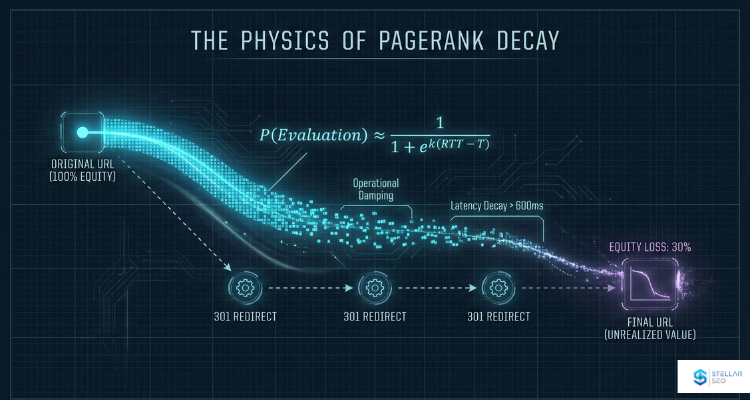
The Physics of PageRank Decay
Short Answer
- Theoretically, no. A properly implemented 301 redirect preserves 100% of PageRank.
- Practically, yes. Operational latency, crawl prioritization, and semantic mismatch can reduce its effective value.
- In plain terms, the authority is not erased, but it is not always usable. Delays, redirect chains, and poor destination matches make Google treat that value as lower priority. This distinction is invisible in most SEO explanations.
What’s Google’s Stance On The SEO Impact of 301 Redirects?
According to Google’s official statements, 301 redirects do not lose link equity.
In 2016, Google’s Gary Illyes confirmed that 30x redirects no longer lose PageRank. John Mueller later clarified that 301 redirects act as canonical signals, meaning authority is consolidated to the destination URL.
That is the answer most searchers are looking for.
However, Google’s guidance assumes a perfect setup. Real websites are messy. Redirects add friction, and that friction reduces how often and how effectively link value is applied.
Disclosure: Let’s be real. I run an SEO agency, not a physics lab. I don’t spend my weekends calculating damping coefficients. However, accuracy matters. So, we brought in a systems engineer to verify the models below. I can’t derive these formulas from scratch, but I know exactly how they show up on real sites and how to fix the damage.
Google’s Official Position vs Operational Reality
Now let’s get into the fun part, or skip ahead to “What Actually Preserves Usable Link Equity” if you just want the takeaway.
The Google Consensus
Google’s position is internally consistent:
- 301 redirects pass PageRank
- There is no intentional dampening applied to redirected URLs
- Canonical signals consolidate authority
From a mathematical standpoint, the scalar value of PageRank is preserved.
The Engineer’s Reality
Preservation at rest is not the same as preservation in motion.
PageRank exists inside a distributed system governed by crawl scheduling, fetch timeouts, rendering budgets, and prioritization queues. Redirects add hops. Hops add latency. Latency affects fetch completion and evaluation timing.
If authority arrives late, intermittently, or inconsistently, it becomes operationally weaker even if it is theoretically intact.
If a wire transfer takes three years to clear, the money exists, but its utility is degraded. Time is a decay factor.
The Physics of Decay: Operational Damping in Redirect Chains
Redirect chains introduce what can be modeled as operational damping.
Each additional 301 hop increases round-trip time, consumes crawl resources, and lowers the probability that a crawler completes evaluation during a given crawl cycle.
Let:
- RTT = total round-trip time introduced by redirects
- T = latency threshold where crawl deferral increases
- k = sensitivity constant under crawl load
The probability that a redirected URL is fully evaluated can be approximated as:
P(\text{Evaluation}) \approx \frac{1}{1 + e^{k(RTT – T)}}
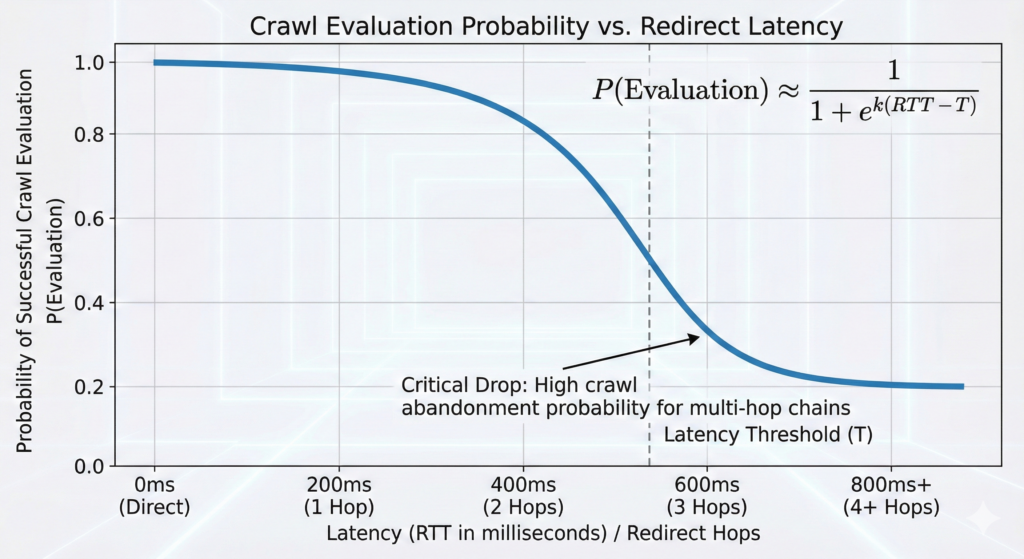
As RTT increases, the probability asymptotically declines. The link is not lost. It is deferred, deprioritized, or evaluated inconsistently.
In real environments:
- A single 301 adds negligible overhead
- A three to four-hop redirect chain can add 500 to 700 milliseconds
- During peak crawl load, these URLs are more likely to be postponed
This does not delete PageRank, but it reduces how often it actively contributes to ranking signals.
A link that is reliably evaluated only 70 percent of the time is functionally weaker than a direct link, even if its theoretical value is identical.
Graph Theory and the Soft 404 Failure Mode
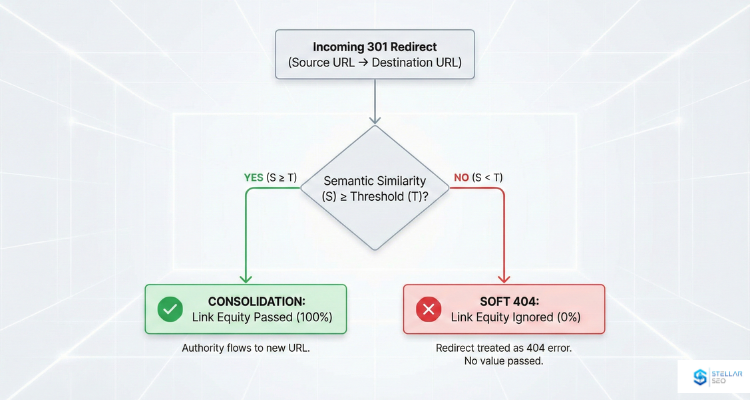
Google evaluates redirects not only by status code, but by destination relevance. When a redirected URL points to an irrelevant page, Google may treat the redirect as a soft 404.
This behavior is documented.
Let:
- S = semantic similarity between source and destination
- T = similarity threshold required for consolidation
- E = effective equity passed
E={100%if S≥T0%if S<TE = \begin{cases} 100\% & \text{if } S \ge T \\ 0\% & \text{if } S < T \end{cases}E={100%0%if S≥Tif S<T
Common failure patterns include:
- Old product page redirected to homepage
- Deprecated service redirected to an unrelated service
- Expired content redirected to a generic category
In these cases, the 301 is accepted technically, but the equity is ignored semantically.
This is how sites lose 100% of the value of strong backlinks while believing they have followed best practices.
Redirects as Financial Assets: Modeling Link Efficiency
Backlinks are capital investments. They have acquisition cost, maintenance cost, and recoverable value.
When redirects introduce operational damping, authority does not disappear. It becomes dormant.
Consider a backlink acquired for $500.
If redirect latency and crawl deferral reduce reliable evaluation to 70 percent, then only 70 percent of that authority is consistently contributing to ranking signals. The remaining 30 percent is unrealized.
Fixing redirect chains, restoring semantic continuity, and reducing latency becomes a matter of asset recovery.
For large sites with thousands of backlinks, small efficiency losses compound into a meaningful loss of link equity and, subsequently, rankings.
Why This Only Matters at Scale
Big sites migrate. They change CMSs. They rename products. They kill pages for legal or compliance reasons. They restructure categories. None of that is optional, but it does lead to a lot of redirects.
Old URLs keep picking up links. Those links flow through two or three redirects to pages that are “close enough” to not break anything. Rankings don’t tank. Nothing catches fire. It just never performs the way it should.
At scale, redirect inefficiency is a drag on authority. You can be spending serious money acquiring links while quietly wasting a chunk of the value you already have.
Most tools will tell you the redirect works and move on. That’s fine if you’re small. If you’re not, that’s how value leaks without anyone noticing.
If you’ve lived through multiple migrations and your site still feels like it’s underperforming, this is usually part of the reason.
What Actually Preserves Usable Link Equity
Link equity is easy to waste.
Every extra redirect hop makes Google work harder. Every time you point an old URL at a page that’s only kind of related, you’re asking Google to give you the benefit of the doubt. Sometimes it does. Sometimes it doesn’t.
Most sites don’t notice because they’re small. A few bad redirects don’t move the needle.
Big sites don’t get that luxury. On large sites, redirect chains stack up quietly. Old URLs keep earning links. Those links point through two or three hops to pages that are “close enough.” Nothing breaks. Rankings just never quite hit where they should.
That’s how link equity gets wasted. Not with a penalty. Not with a warning. Just by slowly doing less work than you paid for.
If you want your links to keep pulling their weight, keep redirects short, keep destinations tight, and stop treating redirects like cleanup tasks you only think about during migrations.
301s pass PageRank. Whether that PageRank actually helps you is up to you.
Final Takeaway
301 redirects don’t magically destroy link equity.
What actually determines whether that equity helps you is whether Google can reach it easily, understand it, and bother to evaluate it consistently.
On a small site, this usually doesn’t matter. If you’ve got a few hundred links, and you’re not doing dumb redirects to irrelevant pages, you’re probably fine.
This becomes a real problem at scale. Losing 30 percent effectiveness across a million links is not the same as losing it across a thousand.
That’s where enterprises and large ecommerce sites get burned. Redirect chains pile up. Old URLs point to “close enough” pages. Everything technically works, but the authority is no longer pulling its weight.
At that level, redirects are asset management, not just an SEO task. If you are looking for a link building agency with experience handling large-scale ecommerce and enterprise-level link building, book a call, and let’s discuss your current situation and goals.
Related Resources