






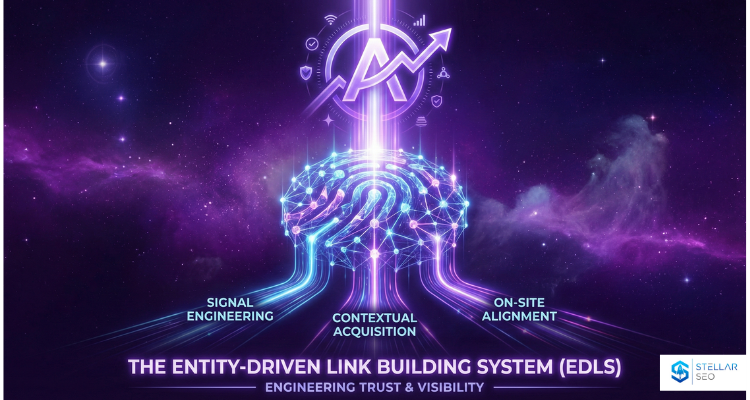
The Entity-Driven Link Building System (EDLS)
Executive Summary: The EDLS Advantage
The Problem: Modern search engines (Google & AI) no longer rank websites solely based on link volume. They rank “Entities” based on signal clarity, trust, and semantic neighborhoods.
The Solution: The Entity-Driven Link Building System (EDLS) replaces the old “spray and pray” outreach model with a precision-engineered framework. We align your brand’s off-site signals with its on-site identity through our custom link building campaigns, based on this framework.
The Outcome:
-
Predictability: Growth becomes a calculated outcome, not a lucky break.
-
Efficiency: You stop wasting budget on links that Google’s vector systems ignore.
-
Defense: Your rankings become resilient to core updates because they are anchored in “Meaning,” not just metrics.
How Modern Brands Build Authority, Trust, and Market Visibility
Search has entered a new era. Google and AI systems no longer reward pages solely based on keyword matching or the number of links.
The brands winning today have clear identities, consistent signals, and strong topical authority. EDLS is the system that aligns your brand with these requirements, enabling you to grow organic visibility with precision and predictability.
If your competitors seem weaker yet outrank you, the issue could be entity signals, not your content or your effort. EDLS solves this by engineering the authority profile that Google and AI use to decide which brands deserve to lead a category.
The Business Problem EDLS Solves
Modern search evaluates Entities, not just pages. The systems that power Google (including the Knowledge Graph) classify companies by their identity and their relationships to specific topics.
The “Signal Gap”: If your digital footprint is fragmented, Google’s algorithms cannot confidently map you to a category.
- The Result: Every link you acquire has less impact. Rankings stall. CAC increases.
- The Fix: EDLS strengthens the “Entity Fingerprint” Google assigns to your brand. When your identity is clear, Semantic Link Building amplifies your visibility, making every new link compound in value.
EDLS fixes your authority at the foundational level, so every future effort compounds.
Your Entity Fingerprint and Why It Controls Visibility
Every brand has an entity fingerprint. It is the combined set of signals that defines who you are, what markets you belong to, and which topics you deserve to rank for. This fingerprint is shaped by your content, citations, backlinks, social profiles, PR, anchors, publisher context, and the conversations happening around your brand.
If the fingerprint is unclear, Google takes a conservative approach. Your content ranks slowly. Your links underperform. Competitors with smaller budgets move ahead because their signals are easier to interpret.
For a deeper explanation of how authority signals influence rankings and AI visibility, read: https://stellarseo.com/backlinks-as-authority-signals/
EDLS engineers your entity fingerprint intentionally. This is the reason our clients outperform competitors who publish more content or buy more links. We increase the amount of authority your brand receives per link.
Why Traditional Link Building Underperforms in Competitive Markets
Most link building programs fail for the same reason. They treat links as isolated assets rather than as signals that shape how Google classifies a brand. In competitive markets, this creates a structural weakness that cannot be fixed with more volume.
Traditional link building focuses on metrics like Domain Rating, traffic estimates, and the number of placements completed each month. Those metrics look attractive in a report, but they ignore the single factor that determines whether a link moves up in rankings. That factor is identity alignment.
When your signals do not reinforce the market and topics you want ownership of, the algorithm places you in the wrong category or assigns you partial relevance. When that happens, even high quality links produce limited authority.
This is why companies with weaker content, smaller budgets, or fewer links often outrank better-funded brands. Their signals are clean. Their link profile points to one clear identity. Their mentions, anchors, and publisher context all support the same topical narrative. Search systems understand them instantly, so Google trusts them sooner.
Traditional link building also breaks during major algorithm updates because it relies on surface-level indicators. These updates target unnatural link patterns, shallow content, and mismatched context across the web.
When your authority rests on volume rather than alignment, performance becomes volatile. Rankings rise, fall, and stall because the underlying signals do not align with how modern search systems assign trust.
The problem is not the links, but the absence of a system that guides which signals you send, where they appear, and how they reinforce your brand. Without that structure, link building becomes an expensive guessing game.
EDLS corrects this by engineering the meaning behind every placement so your authority grows predictably, even in the most competitive categories.
The EDLS Framework
The Entity-Driven Link Building System operates through three strategic levers that mirror how modern search systems evaluate trust, relevance, and authority.
The goal is simple. Align who you are, what you publish, and where you appear so Google gains confidence in your identity and rewards you with visibility.
Pillar 1: Authority Signal Engineering
This pillar shapes the signals that define how Google classifies your brand. When your anchors, mentions, and topical associations all point in the same direction, the algorithm gains clarity. That clarity is what allows authority to compound.
Authority Signal Engineering includes structured anchor planning, topic-to-URL mapping, co-citation placement, consistency across brand mentions, and analysis of the topical neighborhoods your competitors occupy.
These inputs work together to build one unified story about your brand. Once that story is clear, each new link adds more lift than the last.
Pillar 2: Contextual Link Acquisition
Most link building produces links that sit on the web without influencing meaning. Contextual acquisition ensures each placement reinforces the topics you want ownership of.
EDLS evaluates publishers based on the subjects they cover, the audiences they reach, and the semantic signals their content sends. We prioritize placements that help search systems understand your authority, not just sites with high metrics.
This approach relies on publisher qualification, context scoring, editorial review, and relationship-driven outreach that secures real placements. The result is a link profile that expands your authority in the markets you serve and sustains that authority over time.
Pillar 3: On-Site Identity Alignment
Your off-site signals only work if your website expresses the same identity. On-site alignment ensures that your content structure reinforces the topics and intent we are building through your link profile. This includes consolidating fragmented pages, clarifying category relationships, and mapping anchors to the correct destinations to create a semantic moat around your site.
The objective is identity reinforcement, not just traditional on-page SEO. When your content and your link signals support the same narrative, rankings accelerate, and each link carries more weight. This alignment turns link building from a cost center into an authority engine. We call this the Unified Entity Domination for AI & Search system.
Industry Applications: How EDLS Works in Your Market
Every industry sends a different set of authority signals into Google’s ecosystem. EDLS adapts to those signals so your brand is classified correctly from the start. The same engine powers every deployment, but the emphasis shifts based on your regulatory environment, competitive landscape, and customer journey.
Startups move fast and compete against incumbents with years of accumulated trust. EDLS compresses that gap by shaping the entity signals investors, customers, and search systems expect from a high-growth company. Our framework aligns with the velocity required in early markets, as outlined in our Link Building for Startups guide, where identity clarity matters more than raw link count.
Legal and compliance-heavy industries operate in tightly defined topical boundaries. EDLS reinforces the exact themes that allow law firms and regulated brands to be viewed as authoritative sources. Identity alignment prevents dilution and ensures your content sits in the correct semantic neighborhood. Leaders diving deeper into how Google evaluates expertise often review our Knowledge Graph expertise analysis to understand why precision matters.
Finance and fintech brands face scrutiny from regulators and search systems. EDLS focuses on contextual signals that validate credibility and reduce noise around sensitive topics. When every publisher context reinforces trust, organic visibility scales without increasing compliance risk. Concepts from Backlinks as Authority Signals often illustrate how these contextual decisions influence perception.
SaaS and technology companies compete in overcrowded categories where meaning determines who ranks. EDLS strengthens topical alignment around use cases, problem definitions, integrations, and customer intent. Semantic reinforcement is often the difference between ranking for generic terms and becoming the default answer, a concept explored in our Semantic Link Building framework.
Ecommerce and B2B service brands rely on clear category signals, structured product intent, and consistent topical reinforcement. EDLS supports this by building link patterns that match buyer journeys and search behavior. Teams evaluating larger algorithm shifts often refer to How Google Ranks in 2026 to understand why entity clarity increases ranking durability as markets evolve.
Across all industries, EDLS removes uncertainty by shaping the identity Google assigns to you, then reinforcing it through contextual acquisition and structured authority signals. The supporting definitions within our Link Building Glossary expand on the concepts behind this system, but the principle remains constant. When your brand’s entity is understood, your authority compounds.
Why EDLS Works Across Every Competitive Environment
Markets change. Algorithms update. New competitors enter with fresh funding and aggressive campaigns. What does not change is how search systems assign trust. They reward brands that are easy to classify and consistent in their appearance.
EDLS works across law, finance and fintech, SaaS, ecommerce, manufacturing, marine, and B2B service markets because it does not depend on loopholes or niche tricks.
We help you win by focusing on the one factor that scales everywhere: a clear, reinforced entity identity that matches how Google organizes information.
When that identity is stable, you gain three advantages in any environment.
Rankings recover faster after updates. New content gains traction sooner. Each incremental link delivers more authority than it would in a fragmented profile.
For leaders who want to understand the mechanics behind that stability, our guide on how Google ranks sites in 2026 explains the shift to vector-based retrieval and why clarity now outperforms volume.
Results You Can Expect With EDLS
When your identity signals and your link acquisition strategy reinforce the same narrative, authority grows in a controlled, predictable way. That predictability is what executives value. It reduces risk, accelerates visibility, and ensures that organic becomes a reliable channel rather than a volatile one.
EDLS produces results that compound over time. CAC decreases as qualified organic demand rises. Movement into competitive SERPs accelerates because your brand is clearly classified within the topic cluster you want to lead. Algorithm updates become less disruptive because your authority is anchored to meaning, not tactics. Each link adds value by strengthening a signal that already exists. Every new page performs better because it enters the index supported by a clear identity.
These outcomes become even more critical in AI search environments. Systems that generate answers rely on entity clarity, contextual authority, and semantic proximity.
EDLS strengthens the same signals AI models use to determine which brands belong in synthesized results and which ones can be trusted as sources. A consistent brand presence across the web means you appear in more AI surfaces, citations, and retrieval paths.
The result is a scalable, repeatable method for growing authority. EDLS allows your brand to compete at the top of your market without depending entirely on paid channels or unsustainable content volume. It positions your company to perform well in both traditional search and emerging AI-driven discovery.
Authority Comes From a System, Not Tactics
Modern search rewards brands that communicate a consistent identity across every signal they send online. Content volume and link quantity no longer create that authority. A structured system does. EDLS gives you the framework to shape how Google and AI decision models understand your brand, then reinforces that knowledge through contextual acquisition and precise signal alignment.
As a result of having a clear brand identity, rankings rise faster, competitive gaps close, and organic becomes a controllable growth channel instead of a reactive one.
If your goal is to increase visibility, outperform better-funded competitors, and lower acquisition costs by strengthening organic demand, EDLS provides the system needed to get there.