







Executive Overview
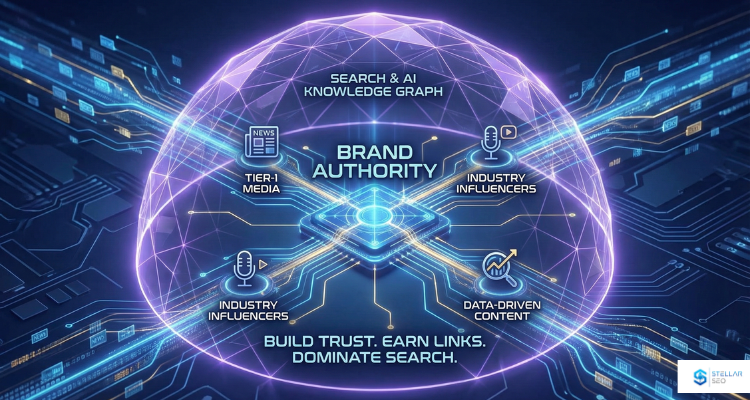
Modern search rewards recognized entities, giving them a distinct advantage over pages optimized solely for traditional SEO. Stellar SEO builds authority by validating brands and their experts across Google’s Knowledge Graph and AI systems. We combine digital PR, entity-driven link building, brand mentions, and semantic moat content to remove ambiguity and establish trust at the entity level. This article breaks down how entity-based SEO works and why recognition, not rankings alone, now determines visibility
The Google Knowledge Graph and the Shift to Entity-Based Search
Early search relied on text matching. Queries were treated as strings, pages were scanned for matching terms, and results were assembled from overlap.
That approach broke as the web scaled. Words are ambiguous, and many businesses describe themselves the same way. Google needed a way to identify what those words referred to in the real world, not just where they appeared.
That shift led to entity-based search.
An entity represents a real-world object that can be uniquely identified. A company, a person, a location, a product, or an abstract concept. Google tracks these entities and the relationships between them inside the Knowledge Graph.
Search results are now shaped by how confidently Google understands those relationships.
What the Knowledge Graph Actually Does
The Knowledge Graph acts as Google’s reference layer. It stores entities and maps how they connect to other entities, topics, and sources.
Rather than asking whether a page uses the right keywords, Google evaluates recognition, consistency, and confirmation. It looks for evidence that a brand exists beyond its own website and occupies a defined position within a topic.
This data powers knowledge panels, brand associations, AI summaries, and recommendation systems. Individual pages benefit from that context, but the underlying asset is the entity itself.
How Entity-Based SEO Works
Older SEO focused on matching words. Entity-based SEO focuses on identifying what those words refer to in the real world.
An entity is something Google can clearly distinguish from everything else. A company. A person. A product. A location. A defined concept. Entity-based SEO is about making it obvious what your entity represents and where it belongs.
Google no longer evaluates pages in isolation. It evaluates whether an entity demonstrates authority within a topic.
That authority is established through three mechanisms.
Topical Salience
Google measures how completely a topic is covered.
When a page addresses a primary topic and consistently includes the related concepts Google expects to see, it carries more weight. Coverage matters more than repetition. A page about link building that naturally includes backlinks, anchor text, referring domains, digital PR, and authority signals appears complete. Pages that miss those connections appear thin.
Completeness raises confidence and raises rankings.
Contextual Linking
Links communicate more than strength. They communicate meaning.
When a relevant publication links to a brand within an editorial context, Google records the relationship. That link places the brand inside a specific subject area, not just on the web at large.
Over time, those relationships define which topics an entity is associated with. This is why links from relevant sources outperform higher volumes of unrelated ones.
Ambiguity Removal
Keywords introduce uncertainty. Context removes it.
Mentions in industry publications, consistent topic coverage, and repeated associations tell Google exactly who an entity is and what it should rank for. Once Google stops second-guessing identity, it stops hedging results.
Clear entities rank with less friction.
Why This Changes Link Building
Link building now functions as entity validation.
Each strong placement confirms where an entity belongs. When a brand is repeatedly referenced alongside established leaders in the same context, Google updates its internal map to reflect that association.
One trusted mention can outweigh dozens of low-quality links because it provides verification, not noise.
Think less about accumulation and more about association. Rankings follow the entities Google understands best.
Why Entity Recognition Changes Rankings
Once Google treats a business as an entity, ranking behavior changes.
Content from recognized entities is evaluated differently. Trust thresholds drop. Topic expansion happens faster. Pages rank across broader query sets because Google already understands who the content comes from and what that entity represents.
This becomes even more pronounced in AI-driven search. Systems like Gemini rely on Knowledge Graph data to validate facts and sources. Brands without entity confirmation rarely surface, regardless of content quality.
At that point, optimization alone no longer closes the gap.
How the Knowledge Graph and LLMs Interpret Authority Differently
The Knowledge Graph and large language models solve related problems, but they operate differently.
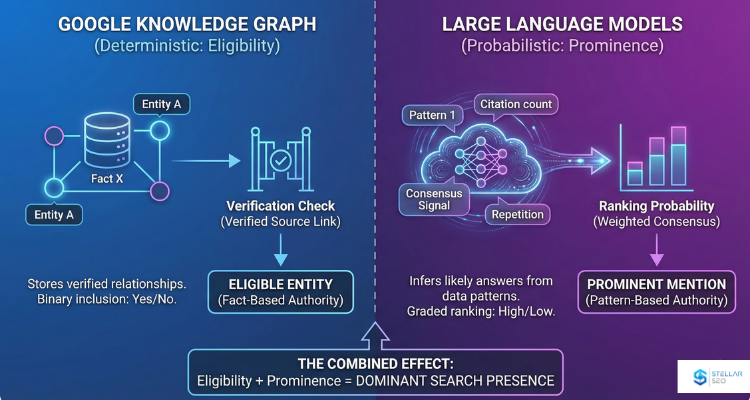
The Knowledge Graph is deterministic. It stores entities and relationships that Google considers verified. When a connection exists, Google can reuse it confidently across search features, AI summaries, and recommendation systems. When it does not, Google proceeds cautiously.
LLMs operate probabilistically. Instead of storing facts in a structured database, they infer likely answers based on patterns across large volumes of text, relying on repetition, consistency, and prominence across trusted sources.
This is where overlap emerges.
When a brand is consistently referenced by authoritative publications, linked in editorial contexts, and discussed alongside the same topics, both systems reach similar conclusions for different reasons. The Knowledge Graph treats those signals as confirmation. LLMs interpret them as consensus.
The difference appears at the margins. The Knowledge Graph requires explicit validation.
LLMs can infer authority without formal inclusion, but only when signals are overwhelming and consistent.
A practical rule follows:
- The Knowledge Graph determines who is eligible
- LLMs determine who is mentioned first
Brands with strong entity signals benefit in both systems. Brands without them struggle in both, even when content quality is high.
That is why link building, brand mentions, and digital PR matter beyond rankings. They generate the repeated external confirmation both structured systems and probabilistic systems rely on.
Consensus as a Ranking Signal
LLMs look for agreement.
A single mention introduces a signal. Repeated alignment across trusted sources removes uncertainty. When authoritative publications reinforce the same positioning, probabilistic systems converge on a conclusion.
This is how consensus forms.
Digital PR that produces scattered coverage creates noise. Digital PR that reinforces a consistent narrative across multiple authoritative sources creates clarity. Once consensus is visible, models stop hedging and start asserting.
How Google Confirms an Entity Exists
Google looks outward for confirmation.
Independent references carry weight. Mentions from authoritative publications, consistent brand citations, and editorial links all act as external evidence. Each one reinforces the same question: Does this entity exist, and does it matter within this topic?
Repetition across trusted sources builds confidence. Over time, Google stops questioning legitimacy and begins using the entity as a reference point.
This explains why some brands dominate visibility with fewer pages while others struggle despite heavy content investment.
The Author-as-Entity Layer
Entity recognition does not stop at the company level.
Google and LLMs increasingly evaluate who is responsible for the expertise. Named individuals carry more weight than anonymous brands, especially in competitive topics.
This is where many agencies stop short. Digital PR should validate not only the business, but the people behind it.
By earning coverage, citations, and professional mentions for executive leadership and subject-matter experts, authority transfers at the human level. When an author becomes a recognized entity for a topic, every piece of content associated with that person inherits trust.
This accelerates authority compounding. The brand benefits, and so does every page tied to that expert.
How Link Building, Brand Mentions, and Digital PR Interact
Digital PR, link building, and brand mentions operate as a reinforcement loop.
Editorial links pass authority and context. Brand mentions without links still confirm existence and topical relevance. Together, they help Google connect a brand to specific concepts inside the Knowledge Graph.
Digital PR produces the strongest inputs. Coverage from trusted publications creates durable associations. Link building transfers that authority into the site. Brand mentions fill gaps where links are absent, but recognition still occurs.
When multiple authoritative sources reference the same brand in the same topical context, Google consolidates that information into a single entity profile.
Experience as the Differentiator
Expertise can be synthesized. Experience cannot.
LLMs are trained on knowledge. They struggle to replicate first-hand outcomes, proprietary data, and documented results. That gap is where experience becomes decisive.
Digital PR places lived work into the public record. Case studies, original research, performance data, and operational insights published in trusted outlets serve as proof that experience exists.
Those signals separate real operators from AI-generated commentary and persist long after publication.
The Role of Social Signals and Distribution
Social platforms do not pass traditional link equity, but they influence entity recognition indirectly.
Content that gains traction on platforms like LinkedIn, X, or industry-specific communities increases the likelihood of secondary coverage. Journalists and editors frequently source stories from social discovery.
That exposure leads to citations, mentions, and editorial links elsewhere. Social activity acts as an accelerant, not a ranking factor on its own.
For entity building, distribution expands the surface area where validation can occur.
On-Page SEO and the Semantic Moat
External validation alone is insufficient. On-page structure determines whether Google can align off-site signals with on-site meaning.
Semantic moat content reinforces entity positioning by fully covering the concepts Google associates with a topic. Pages are structured around entities, attributes, and relationships rather than isolated keywords.
Internal linking connects those concepts deliberately. Supporting pages feed authority into core pages. Schema markup clarifies identity, ownership, and relationships.
When on-page semantics align with off-site validation, Google encounters the same signals repeatedly, from multiple directions, without contradiction.
That consistency accelerates trust.
How the Pieces Fit Together
Entity authority is built through repetition across systems that Google and LLMs already trust.
- Digital PR places the brand and its experts in authoritative publications. Those mentions create independent reference points outside your site.
- Link building connects those references back to owned pages. Editorial links carry context and trust into the areas you want to rank.
- Brand mentions reinforce recognition even without links. They show independent discussion and reduce reliance on any single source.
- Social distribution increases exposure to people who create secondary coverage. That visibility leads to additional citations without forced outreach.
- Semantic Moat content aligns the site with external narratives. Pages cover the same entities and relationships discussed off-site. Internal links concentrate authority where it matters.
- Schema resolves identity. It tells Google which entity those signals belong to and how they connect.
When these signals are consistently repeated, they remove doubt. Once that happens, the entity starts getting reused instead of re-evaluated.
Why This Matters Now
Search results increasingly reflect pre-ranked entities rather than isolated pages. AI-driven interfaces narrow that list further.
Brands that fail to establish entity authority are filtered out early. Brands that succeed benefit across search, discovery, and AI recommendation systems at the same time.
If Google and LLMs do not trust you, they do not surface your content.
Sources
-
-
Introducing the Knowledge Graph: Things, Not Strings Written by Amit Singhal in 2012, this is the original announcement that shifted Google from keyword matching to entity recognition.
-
Entities in Search (Google Search Central). This documentation explains how Google uses structured data to understand the people, places, and things on a page.
-
Understand How Structured Data Works: A technical guide on providing explicit clues to Google about the meaning of your content through Schema markup.
-
Google Patent: Ranking Search Results Based on Entity Metrics. This patent details how Google uses the Knowledge Graph to determine metrics such as relatedness and contribution to ranking search results.
-
Wikidata: Introduction to Wikidata. Wikidata is a primary data source for the Knowledge Graph. This page explains how structured data is stored and interlinked.
-
Wikipedia: Knowledge Graph An overview of the history and implementation of knowledge bases used in modern search engines.
-
Kalicube: What Core Information Does Google Use? This article explains the specific data points Google extracts from the Knowledge Graph to build brand profiles.
-
- How Google Ranks Websites In 2026. This article explains the combined factors and retrieval systems Google is now using to evaluate and rank websites.
- How AI Changed Link Building. This guide explores how AI has impacted link building and how you must adapt to be successful in 2026.
-