
Stellar SEO’s AI SEO services help your business build a stronger presence across the websites, publications, and conversations buyers use to choose a provider. We combine strategic link building, brand mentions, digital PR, and relevant third-party placements with research into the sources appearing in AI search.
If competitors keep getting recommended while your business is missing, we investigate why. Then we build a campaign around the coverage, context, and external credibility your brand needs to compete in traditional search and AI-generated answers.
Relevant publishers. Clear deliverables. An outreach strategy built around your market.
You can describe your company as experienced, trusted, or a leader in your field. Buyers still need reasons to believe it.
An industry publication quoting your expertise, a useful comparison explaining your strengths, or a relevant review discussing your work gives them more to consider. Our AI SEO approach builds that wider body of information around your business.
We start with the sources showing up in AI-driven search engines for questions your customers actually ask. From there, we assess where your brand belongs, what you can contribute, and which opportunities are worth pursuing. This keeps the campaign connected to buying decisions and gives every placement a purpose.
Our AI optimization campaigns combine the services that address your biggest gaps in traditional SEO and AI visibility. Some businesses need stronger links to important service pages, while others need broader coverage in comparisons, industry publications, and expert discussions. We scope the work around your starting position and goals.
Our link building services remain the foundation. We research publishers in your market, assess their relevance and editorial quality, and develop outreach around content their readers can use.
That work can include guest posting and blogger outreach, expert contributions, and suitable opportunities within existing content. We consider the page, audience, and surrounding discussion alongside the website’s metrics.
For generative engine optimization (GEO) campaigns, we also investigate whether prospective publishers appear in Google AI Overviews, ChatGPT, Perplexity, and other relevant AI search results. We then consider placement selection while preserving the traditional SEO value of the campaign.


When someone uses AI-powered search to ask which company to hire, your service page is only part of the information they may encounter. Industry roundups, best-of lists, brand reviews, and comparison articles can introduce your business and explain where it fits.
We identify relevant opportunities and give publishers a factual reason to consider you: specialist experience, a distinctive service, original research, or documented results. Linked and unlinked brand mentions both belong in this work when they provide useful context.
For example, a specialist lender may be a strong fit for an article comparing financing options for property investors. A mention explaining its borrower requirements and loan types gives readers substantially more information than a name dropped into an unrelated article.
Your team knows things that could make a worthwhile story. That expertise gives both traditional SEO and generative engine optimization campaigns something substantial to promote. We help identify those angles and build outreach around them.
Campaigns can draw on anonymized customer data, recurring industry problems, expert analysis, or original studies with a clear methodology. The objective is to give a journalist, editor, or industry writer something useful to cover and attribute to your business.
Press releases can support that work when there is news to announce. We prioritize new information and a relevant audience over distributing the same generic announcement across dozens of sites.
Some topics benefit from an expert explaining them on video, while others suit a detailed LinkedIn article, a Medium post, or a podcast conversation. Our optimization strategies for generative search environments include these formats where audience research and the agreed campaign scope support them.
Each contribution needs a clear purpose and enough substance to stand on its own. A YouTube video with an accurate transcript might answer a difficult buying question, while a LinkedIn article could explain what your team is seeing in the market.
We distinguish content published through your own accounts from independent coverage. While both can support discovery, they provide different kinds of evidence about your brand.
Relevant discussions can reveal what customers misunderstand, which providers they compare, and what makes them hesitate. We use those insights to improve campaign priorities and identify worthwhile participation opportunities.
Where Reddit or other community work is appropriate, we can help you contribute useful information, respect community rules, and disclose relevant affiliations.

External coverage works best when customers can reach a useful, credible website. Before investing heavily in promotion, we review the pages the campaign will support and identify weaknesses that could limit their performance.
Supporting work can include:
Technical SEO: Reviewing crawl access, indexing, canonical signals, and other barriers to discovery.
On-page content: Checking that service pages answer buyer questions, explain your strengths, and support important claims.
Structured data: Reviewing relevant markup for accuracy and consistency with the visible page, including how structured data describes your business and services.
Internal linking: Helping visitors and search engines find related services, evidence, and useful resources.
We can scope supporting recommendations internally or coordinate with your existing team. This keeps traditional SEO, answer engine optimization, and the off-page campaign working toward the same goals.
You get a defined AI SEO campaign with an agreed mix of research, outreach, content, and reporting. Our AI SEO proposal sets the volume, cadence, and responsibilities for each component.
Your team provides the business knowledge, such as service details, approved claims, subject-matter expertise, and access to relevant reporting, while we handle the campaign research, prospecting, outreach, and placement reporting within the agreed scope. Content approval and any website implementation responsibilities are established at the start.
Deliverable | What it includes |
|---|---|
Search & AI Authority Gap Analysis | A review of your external coverage, competitor presence, and relevant sources appearing in AI answers across the agreed AI platforms. |
Campaign priorities | Target services, buyer questions, publisher opportunities, supporting assets, and the reasons behind each priority. |
Outreach and placement work | The agreed mix of links, mentions, editorial opportunities, digital PR, and distribution. |
Live placement record | Published URLs, placement types, links or mentions, and the topics each placement supports. |
Performance reporting | Changes in the agreed AI engine visibility measures, traditional SEO performance, and business outcomes where data is available. |
Next-step recommendations | Remaining gaps, new opportunities, and adjustments based on the work completed and results observed. |
We establish your current AI visibility using an agreed set of questions about your services, competitors, and market. We record whether your brand appears, how it is described, and which pages are cited.
Keyword research and existing data from Google searches help us connect these questions to commercial priorities. A business with several services may need to focus first on its most valuable category rather than spread the budget across everything it offers.
We review competitor coverage and inspect the sources appearing in relevant AI-generated answers, including Google AI Overviews. While a cited website is the first lead to investigate, we still need to assess its relevance, quality, and whether an appropriate placement is realistic.
This stage turns the broad objective of improving AI engine visibility into specific actions, such as pitching an expert contribution, pursuing a relevant comparison, promoting a useful study, or strengthening links to a priority page.
We develop the supporting material, carry out outreach, and record completed placements. As the campaign progresses, we repeat the agreed visibility checks and review the evidence alongside traditional SEO performance.
AI-generated responses can change between searches as questions, sources, and AI models vary. We look for patterns across reporting periods and adjust priorities when the sources, competitive picture, or available opportunities change.
Stellar SEO has been delivering authority-building campaigns since 2012. Our experience includes markets where publishers expect subject expertise and buyers need strong reasons to trust a provider.
Case Example:
In our financial services link building case study, a national DSCR lender grew from approximately 3,000 to 36,000 monthly organic visitors during the engagement. Referring domains increased from 180 to more than 1,000.
The campaign focused on relevant finance and real estate publishers, contextual links supporting lending pages, and stronger topic alignment. These traditional SEO results demonstrate the research and outreach experience we bring to the off-page component of generative search optimization.
AI SEO aims to improve how a business is discovered and represented in AI-generated search experiences. That can include mentions, recommendations, and source citations across Google AI Overviews, Google AI Mode, ChatGPT, Perplexity, and other AI platforms.

Generative engine optimization (GEO) describes work focused on visibility within these AI outputs. It builds on search engine optimization while accounting for how information is presented in generative search.

Answer engine optimization (AEO) overlaps with GEO, with an emphasis on providing information useful for direct answers. Agencies use these terms differently, so the deliverables matter more than the label.
At Stellar SEO, our focus is external authority. That is, relevant coverage that helps people evaluate your business and expands the information available about it across the web.
Area | Traditional SEO | AI search optimization adds |
|---|---|---|
Visibility | Your pages’ presence in organic search results on traditional search engines. | Whether your business is mentioned, recommended, or cited in generated answers. |
Research | Keywords, search intent, competing pages, and backlinks. | Buyer prompts, competitor recommendations, and the sources supporting AI responses. |
Off-page work | Relevant links and coverage supporting your brand and pages. | Opportunity research around third-party sources appearing in relevant AI answers. |
Measurement | Search visibility rankings, organic visits, leads, and revenue. | Repeat observations of brand inclusion, description accuracy, recommendations, and citations. |
Both approaches belong in the same plan. Traditional search still brings customers to businesses, and familiar SEO foundations remain relevant to AI-powered search experiences. Generative engine optimization broadens what we investigate and measure.
AI search gives customers another way to discover businesses, compare options, and decide whom to contact. Research across consumer and business markets shows why that visibility deserves attention:
An estimated 45% of U.S. consumers use AI tools for local business recommendations.
A McKinsey survey revealed that 50% of surveyed U.S. consumers intentionally seek out AI-powered search engines.
The same research revealed that 44% of AI-powered search users named it their primary and preferred source of insight.
The study further found that, in a variety of sectors ranging from financial services to consumer-packaged goods, 65% of sources in Google AI Overviews came from publishers, user-generated content, and affiliate sites.
In a study by Forrester,94% of business buyers reported using AI during their buying process.
For your business, the opportunity is to be accurately represented where customers are researching their options. That is why Stellar SEO’s AI SEO services combine relevant links, brand mentions, and third-party coverage with analysis of the sources appearing in your market’s AI-generated answers.
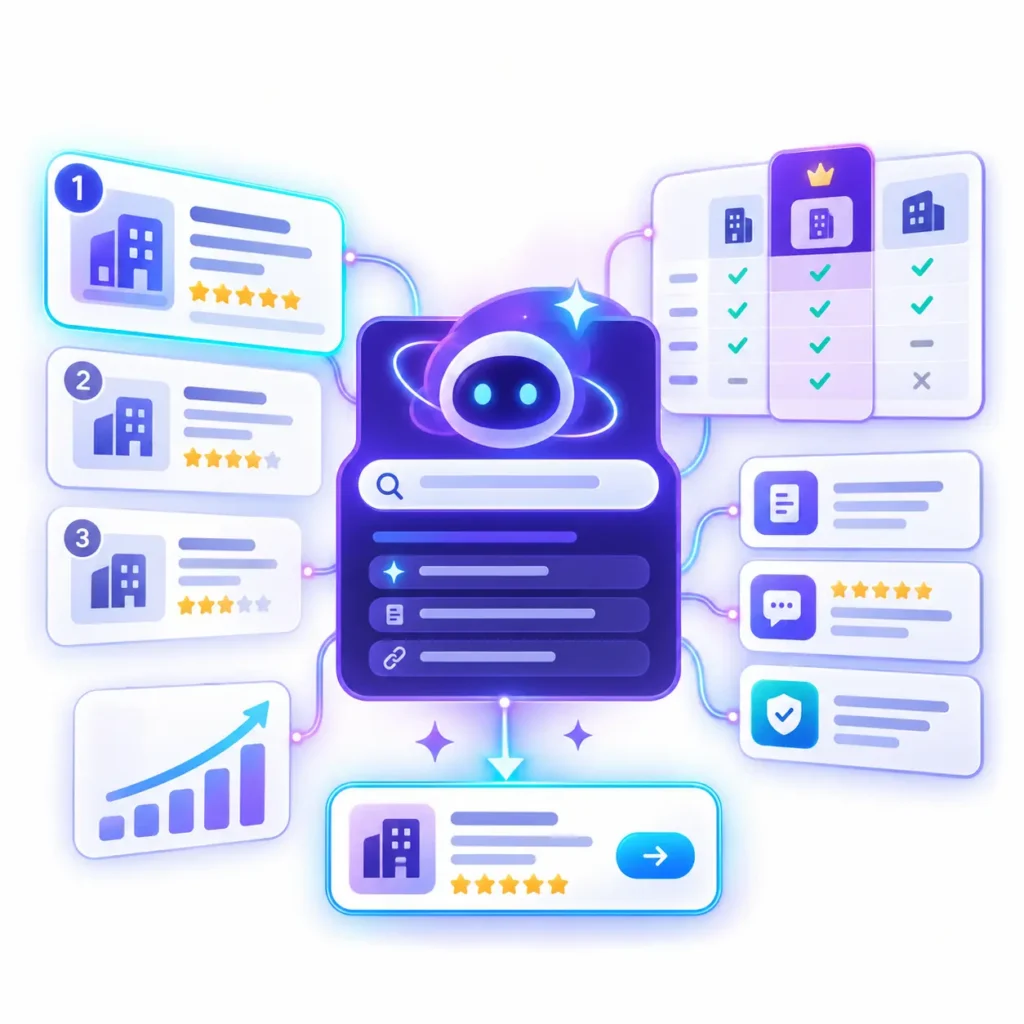

We agree on the AI platforms and questions that matter to your campaign, then use a documented testing approach. The question, date, platform, and source pages provide context for each observation.
Google AI Overviews: We examine relevant search queries, the overview itself, and the pages it cites. We record whether your brand appears in the AI summary itself or within a cited article. These are different outcomes, whereby a source link in AI Overviews does not necessarily mean the answer recommends your business.
Google AI Mode: We assess relevant comparisons and exploratory questions, including agreed follow-ups. Google AI Mode visibility is tracked separately from Google AI Overviews so the report makes clear where an appearance occurred.
ChatGPT, Perplexity, and other agreed platforms: We review mentions, recommendations, descriptions, and source links. We also flag material inaccuracies about your services that may warrant investigation into the underlying sources.
Your report connects these observations with the work delivered and the business data available. We assess AI-generated summaries and recommendations alongside traditional SEO results, rather than treating every appearance as equally valuable. That can include organic performance, referral traffic, qualified inquiries, and branded search growth. We distinguish direct referrals from broader changes that cannot confidently be attributed to one placement or channel.
No. Using AI tools to assist with research, analysis, or content production concerns how tasks are performed. Our AI SEO services focus on your business’s visibility in AI-generated answers. Tools may support the work, but the service centers on research, relevant outreach, external coverage, and measurement.
AI search engines can retrieve web pages and use language models to assemble an answer. Understanding how large language models use retrieved information helps explain why the same business can appear differently across platforms. AI systems may select different sources for related questions, so our generative engine optimization (GEO) research examines both the answer and the pages behind it. We compare observations across Google’s AI features, ChatGPT, Perplexity, and other agreed systems.
Yes. We can focus on off-page AI SEO while your team handles content, technical SEO, and website implementation. We agree on target pages, priorities, and reporting responsibilities together. We also provide white-label link building to SEO agencies looking specifically for outsourced backlink fulfillment.
No. The scope follows the opportunity. If relevant industry publications and comparison pages offer the strongest openings, that is where we focus. Video, original research, and community participation are included when there is a clear reason to use them and the resources to deliver them properly.
Timing depends on your starting position, the work required, and publisher response times. Placement delivery, traditional SEO progress, and changes in AI visibility run on different timelines. We establish delivery milestones in the campaign plan and assess visibility through repeated checks of the agreed AI systems.
No AI optimization agency controls which sources AI systems select or which businesses they recommend. As your AI SEO agency, we commit to the agreed campaign work and transparent reporting. Publisher decisions, platform changes, and variation between answers mean a guaranteed recommendation would be a promise we cannot responsibly make.
We price campaigns around research scope, competition, placement requirements, content development, and reporting. You receive a proposal explaining the work, costs, and responsibilities before committing. The initial discussion helps establish whether you need focused link building or a broader search and AI authority campaign.
When comparing the best AI SEO agencies for your needs, ask to see a sample plan, placement standards, and reporting format. An AI SEO company should explain how opportunities are selected and how success will be assessed. A generative engine optimization agency should also distinguish traditional SEO results from measured AI outcomes.

Find out where your business stands before deciding what to build.
We will review your existing links and third-party coverage, competitor mentions, relevant sources in AI search, and opportunities connected to your priority services, so you can have a clearer picture of what is missing and where a focused campaign could make sense.
Request your authority gap analysis to discuss AI SEO services built around your business, your market, and the customers you want to reach.
Achieving an exceptional digital presence requires experience, careful planning, and creativity.

Travis Bliffen is the founder and CEO of Stellar SEO, a 2x Inc. 5000 honoree known for developing link building and advanced SEO strategies for competitive, regulated markets like legal and finance.
Travis’s work has been featured in publications including Search Engine Land, Search Engine Journal, and Semrush, where he contributes on topics such as authority development, entity-driven SEO, and modern link building frameworks.