







Executive Summary
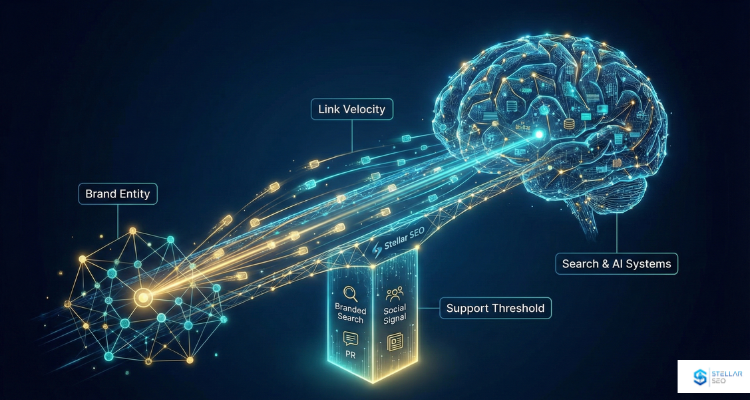
Link building has shifted from a volume tactic to a signal of entity validation. Link velocity is evaluated against a Support Threshold, the level of brand activity required to justify growth when assessed by search engines.
This guide explains how link acquisition shapes how search algorithms and LLMs associate a brand with specific expertise and location. Authority scales when link growth aligns with demand, language is consistent, and real-world visibility is present rather than artificial acceleration.
Understanding Link Velocity in Modern SEO
Link velocity refers to the rate at which new links appear and disappear within a backlink profile over time. Search engines evaluate this movement to assess momentum, consistency, and context, not just raw volume.
Link velocity matters because modern search algorithms look for patterns that reflect real-world relevance, supported by surrounding signals, rather than isolated bursts that suggest manipulation.
Why Search Engines Care About Link Velocity
Before rankings change, search engines evaluate how inbound links accumulate to determine whether authority is being earned or manufactured. Link velocity is assessed as a pattern over time, not as a single data point.
When link growth aligns with brand demand and topical relevance, visibility improves across competitive results in Google. When velocity spikes without context, those same systems classify the pattern as unstable and increase scrutiny.
Positive link velocity strengthens SEO performance when links originate from relevant referring domains and remain active long enough to confirm durability. High link velocity without relevance introduces risk, especially when growth is driven by artificial link sources, spammy links, or large volumes of inbound links that lack editorial context.
Link Acquisition as a Semantic Signal
Link acquisition acts as a semantic event. Each mention contributes to how search engines interpret topical focus, jurisdiction, and expertise.
This process directly influences how your firm is mapped within a search engine’s Knowledge Graph. By analyzing link clusters and the sentiment of surrounding content, AI models compute Vector Embeddings for your brand. This mathematically places your entity closer to specific high-value categories like ‘Chicago Truck Accident Authority’ and further away from ‘General Personal Injury’ based on the density of those semantic connections.
Backlink growth driven by high-quality links from sites within the same topical and geographic neighborhood carries more weight than higher volumes from unrelated sources. Natural backlinks and quality backlinks reinforce legitimacy. Unnatural links distort the backlink profile and increase penalty risk.
Link acquisition functions as a semantic signal because the surrounding language becomes part of the entity’s definition. When a link appears, the words around it operate as descriptive tags that shape meaning over time.
If links are earned around truck accident coverage, the surrounding signals must repeat the same vocabulary. Terms like logbooks, settlement, and liability reinforce each other. To an LLM, the mention of Regulatory Entities like the FMCSA (Federal Motor Carrier Safety Administration) or the DOT (Department of Transportation) alongside your brand serves as a primary trust signal. When those terms appear alongside consistent geographic references, the entity becomes anchored to a specific place and practice area.
When link velocity and supporting language align, search engines and LLMs associate those terms with the brand as a unified concept rather than disconnected mentions.
Measuring Velocity Without Chasing Volume
SEO professionals often ask how many backlinks are required to rank. The better question looks at how many links arrive during the same period while the site’s topic, location, and positioning remain consistent. New links matter most when they reinforce the same authority signal rather than arriving across unrelated phases of growth.
Link velocity analysis evaluates new backlinks, lost links, referring domains, and link types together over time. A significant drop caused by lost links can weaken organic traffic even when total link counts still appear strong.
Why Link Velocity Cannot Exist in Isolation
Link velocity never stands alone. Search engines evaluate whether a spike in backlinks is supported by parallel signals that explain why attention is increasing. Established brands generate this support naturally through press coverage, audience discussion, and growth in branded search when they release news or launch products. Those signals contextualize velocity and reduce uncertainty during evaluation.
When support exists, link velocity appears earned. When it does not, the same growth pattern introduces risk and triggers closer scrutiny.
Search engines like Google expect alignment between backlink growth and broader visibility signals because unexplained momentum is statistically more likely to reflect manipulation than demand.
What “Support” Looks Like to Search Engines
Support is the surrounding evidence that explains why links are appearing and why attention is increasing at a specific moment. Search engines look for multiple, reinforcing signals that validate momentum rather than isolated link activity.
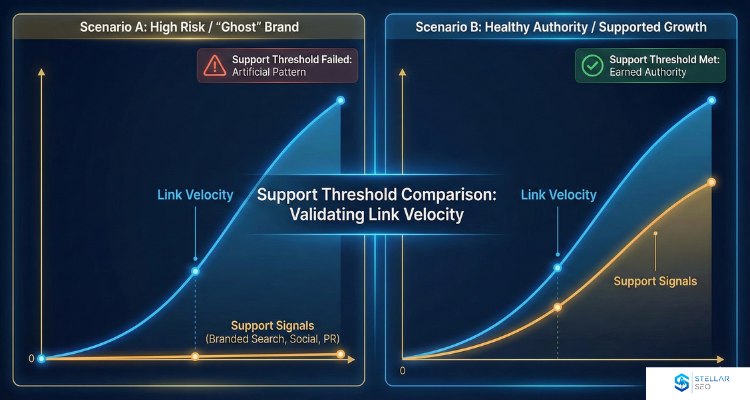
Support commonly includes:
- Branded search growth that rises alongside backlink acquisition, signaling real user demand
- Brand mentions without links across news sites, industry publications, forums, and commentary, confirming awareness even when no backlink is present
- Social media mentions and publishing activity, including the brand posting heavily ahead of a launch, announcement, or campaign, to generate visibility and attention
- Consistent narrative language repeated across coverage, content, and discussion around the same entities and topics
- Referring domains that already co-occur within the same topical and geographic graph
For major brands, this support appears naturally through PR, audience reach, and ongoing discussion. For smaller or newer sites, these signals must be built deliberately so backlink growth has a clear and credible explanation when evaluated by systems like Google.
Why New Sites Face a Different Velocity Constraint
Brand-new sites do not start with baseline brand awareness or existing search interest. They lack press attention, branded search volume, and audience momentum. High link velocity without support from these signals creates a credibility gap inside the backlink profile.
Search algorithms compare link velocity trends against brand maturity, historical activity, and known link sources. When new backlinks arrive faster than the site’s visibility footprint grows, systems classify the pattern as synthetic rather than earned and apply additional scrutiny before trust is extended.
Established brands can absorb faster velocity because supporting signals already exist. New sites cannot. Without a clear strategy, these missing signals cause many link building campaigns to fail.
Manufacturing Support Without Triggering Risk
New sites still need momentum, but velocity must be earned in stages. The constraint is whether growth can be clearly explained during evaluation
Instead of leading with volume, link building efforts should establish enough visible support to justify acceleration. That support creates the context search engines expect before link velocity increases.
Practical ways to establish that support include:
- Structured content releases that establish clear topical focus
- Data-driven PR that explains why coverage and links exist
- Early mentions from niche, lower-risk referring domains already aligned with the topic
- Gradual backlink growth paired with measurable increases in branded search
This sequencing allows link acquisition to appear explained rather than abrupt, even when velocity is intentionally increased.
Support as a Velocity Multiplier
Support changes how link velocity is interpreted during evaluation. When support is present, fewer links carry more authority because growth aligns with visible demand and consistent context.
Healthy link velocity emerges when backlink growth, referring domains, and external visibility rise together. In that environment, velocity reinforces confidence rather than triggering scrutiny.
Support does not eliminate risk. It explains momentum and allows link velocity to scale without distorting perception.
Why This Concept Matters
This concept separates brands that scale authority from sites that stall after an early push. Link velocity is the observable signal. Support is the justification behind it.
The Support Threshold defines how much non-link brand activity is required to justify a given rate of link growth when evaluated by search engines. Link velocity is interpreted relative to brand visibility, not in isolation.
Established brands cross this threshold naturally through press, audience demand, and branded search. New sites do not. When link growth exceeds the Support Threshold, velocity appears manufactured. When growth stays within it, velocity appears earned.
This is the practical reason aggressive link building in the first month often fails. Velocity itself is rarely the problem. Support determines whether growth is trusted.
Good, Healthy, and Optimal Link Velocity
Good link velocity reflects steady acquisition from trusted link sources that reinforce existing authority without drawing scrutiny. Growth appears consistent and explainable within the site’s current visibility footprint.
Healthy link velocity adds persistence, topical alignment, and brand reinforcement. Links remain active, originate from relevant referring domains, and coincide with broader visibility signals, allowing growth to scale without raising uncertainty.
Optimal link velocity balances backlink growth with demand signals and referral quality. At this level, velocity accelerates while remaining supported, keeping growth within acceptable thresholds during evaluation.
High link velocity works when growth mirrors real interest. Velocity trends shift negatively when links disappear, competitors absorb attention, or adversarial activity introduces noise through spammy or unnatural links. These shifts matter because they change how momentum is interpreted, not just how many links remain.
Link Velocity Metrics and Practical Evaluation
Link velocity shows whether authority is strengthening, stalling, or eroding. SEO tools help website owners monitor these shifts, compare velocity trends, and surface unnatural patterns before they distort perception.
A simple link velocity formula compares new backlinks against lost links within the same window while weighting referring domains more heavily than raw link counts. The goal is directional clarity. Is your site gaining or losing popularity?
Strategy, Campaigns, and Long-Term Authority
A modern link building strategy integrates content, PR, and outreach into a single campaign that compounds authority over time. Backlinks that persist and attract follow-on citations carry more weight than short-term placements.
Link schemes and low quality sites fail because they cannot support sustained velocity. Long-term authority requires controlled growth tied to real demand.
That level of execution requires custom link building. Timing, support signals, topical alignment, and persistence have to be managed deliberately. Scalable authority is built through tailored outreach and editorial placement, not volume-driven packages.
Why Velocity Still Separates Winners
Link velocity still separates winners because search engines favor growth that makes sense over time rather than accumulation for its own sake. Search engine results pages consistently reward entities with stable backlink profiles, durable referring domains, and ongoing validation that explains why attention continues to grow.
Website owners who chase volume without regard for velocity trends introduce uncertainty into their backlink profiles. Those who align link building, acquisition timing, and profile quality send clearer signals as growth scales. Over time, that difference determines which brands compound authority and which ones stall.
Link velocity is also a critical signal for RAG (Retrieval-Augmented Generation) systems. When an AI model searches the live web to answer a user query in real time, it prioritizes entities with recent, high-velocity ‘Support’ signals. If your velocity is consistent and current, you are more likely to be cited as the definitive answer by an AI agent.
Link Velocity FAQs
Can I use paid social media campaigns to manufacture support for a link spike?
Yes. Branded traffic, brand mentions, and social activity are valid indicators of real-world interest. When a paid campaign drives meaningful user attention at the same time links are acquired, the Support Threshold increases. Search engines observe the correlation between rising awareness and link activity, which makes higher link velocity easier to justify.
Does link velocity matter for nofollow links?
Yes. Link velocity functions as a brand-level signal, not a link equity calculation. Even when links do not pass direct ranking value, a sudden increase in mentions on authoritative sites signals relevance and momentum. For LLMs and entity-based systems, total citations contribute to your digital footprint regardless of follow status.
How do I estimate my own Support Threshold?
There is no fixed number, but you can estimate it by studying competitors. Compare your branded search volume, press coverage, and visibility against the rate at which top-ranking firms acquire links. If competitors average five new links per month with consistent brand demand, and you attempt four times that velocity without comparable visibility, you are likely exceeding your threshold.
What happens if my link velocity drops suddenly?
A sharp decline often signals reduced attention or the end of a concentrated campaign. If links decline while traffic, branded search, and visibility remain stable, the impact is usually limited. Risk increases when both links and support signals drop together, since that pattern suggests lost relevance rather than a pause in promotion.