








Executive Summary
Mass tort dominance is a race for authority. While generalist agencies focus on content, Stellar SEO provides the link building firepower required to dominate national search.
We build the organic infrastructure that allows your firm to own results for emerging torts before the market saturates. Our system secures high-authority links at scale, providing the speed and permanence needed to outpace national competitors and reduce reliance on lead brokers. Coupled with our semantically rich and entity-enhanced content and internal linking expertise, we’ll help your firm land more plaintiffs.
If two firms publish the same quality content for a new drug recall, the firm with the stronger “entity authority” wins the ranking. Stellar SEO builds that authority so your firm ranks first as the search volume spikes.
Authority First SEO for Mass Tort Law Firms
Mass tort litigation is one of the most challenging arenas in legal marketing because clients start researching long before they know an attorney can help them. They search for symptoms, recall information, and patterns of harm tied to unsafe drugs, defective medical devices, toxic exposure, or corporate negligence. If your firm does not appear during this first research window, your competitors will sign the highest-value clients before you enter the conversation.
Mass tort SEO positions your firm at the top of these searches. It increases organic traffic, secures visibility for high-search-volume topics, and establishes your practice as a trusted resource before people decide who to contact. Firms that maintain this early presence qualify more clients, enter more MDLs, and scale intake consistently across current and emerging torts.
Our approach is built around an authority-first SEO strategy. We build advanced SEO strategies for mass tort law firms by combining our semantic moat and entity-driven link building into a cohesive framework called Unified Entity Domination.
The law firm SEO team at Stellar SEO has built mass tort campaigns for Mesothelioma, Camp LeJeune, Roundup, Talcum Powder, Paraquat, 3M, and several other well-known mass tort cases. What follows is a practical guide based on what works in real campaigns.
Proven Results in National Mass Tort Campaigns
Each campaign required a different blend of medical alignment, content depth, and link acquisition, but the outcome was the same: early visibility, high qualification rates, and strong national presence.
Performance Snapshot
- Camp LeJeune: Top three national rankings for high-value qualification terms
- Roundup: First-page visibility across injury, exposure, and MDL update clusters
- Talcum Powder: Strong national footprint for medical condition and claim criteria pages
- Paraquat: Page-one performance across symptoms, exposure pathways, and qualification queries
- 3M: Authority growth across hearing loss, device failure, and manufacturer conduct pages
These results were driven by a disciplined structure: medically accurate content, entity-focused topical coverage, and an authority-building system built for the speed and volume of national mass tort competition.
Firms partnering with Stellar SEO gain earlier visibility, stronger intake performance, and lower acquisition costs as rankings compound over time.
What Is Mass Tort Lawyer SEO?
Mass tort lawyer SEO improves your online visibility so your firm ranks for searches connected to mass tort claims, mass tort lawsuits, and the medical or environmental issues that cause them.
It aligns content, site structure, and authority signals so search engines understand your expertise and present your pages to people researching their injuries. In simple terms, SEO for mass tort lawyers makes sure the right clients can find you when they start looking for answers.
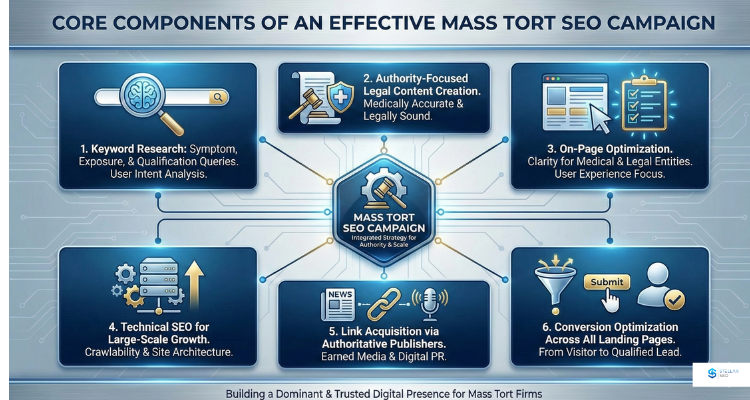
Core components of an effective mass tort SEO campaign include:
- keyword research tied to symptom, exposure, and qualification queries
- authority-focused legal content creation
- on-page optimization for medical and legal clarity
- technical SEO that supports large-scale growth
- link acquisition through authoritative publishers
- conversion optimization across all landing pages
This strategy is built around how users search during the discovery phase. Your content must answer their questions accurately and in depth so users can trust the information immediately.
A scalable mass tort SEO framework requires structured landing pages, detailed supporting subpages, entity alignment, clean internal links, and authoritative off-page signals.
When these elements work together, search engines view your site as a reliable resource for pharmaceutical litigation, toxic exposure, and defective product claims. That recognition results in stronger rankings and earlier visibility across all mass tort topics.
Why Mass Tort Law Firms Need SEO
Mass tort firms need predictable visibility because intake volume depends on appearing before competitors when public awareness spikes. When a recall is announced, when adverse event reports increase, or when national news coverage exposes corporate negligence, search volume surges instantly. Firms with established SEO foundations capture that demand, while firms without it spend months trying to catch up.
SEO gives you leverage that no paid channel can match. Rankings for high-intent mass tort topics compound over time, lowering your acquisition costs and producing a steady flow of prospects who are already informed and motivated. This creates stronger qualification rates and reduces dependence on expensive media buys or lead brokers.
Visibility also matters across regional searches, even for national firms. Optimized Google Maps profiles, accurate location pages, and consistent directory data give potential clients confidence that your firm is legitimate and reachable. These signals help convert visitors who prefer working with a firm that maintains a real presence in their state or city.
Modern SEO tools, including Google Search Console, allow you to track how people discover your mass tort pages, which questions drive traffic, and where your site gains or loses visibility. This data shows which torts are expanding, which need more supporting content, and where link acquisition will have the greatest impact. Firms that review this information consistently outperform those that wait for cases to emerge before adjusting strategy.
A disciplined SEO framework gives mass tort firms the one advantage the competition cannot easily duplicate: long-term authority that compounds across every tort you pursue.
Understanding the Economics Behind SEO for Mass Tort Lawyers
Mass tort firms often evaluate marketing on cost per signed case rather than cost per click. SEO directly influences that metric by lowering acquisition costs over time and improving qualification rates.
A strong SEO strategy improves intake economics in three ways:
- Earlier Visibility
People find your pages before reaching lead brokers or referral networks. This reduces reliance on high-cost channels. - More Informed Prospects
Visitors who arrive through organic search spend time learning symptoms, criteria, and claim requirements. These individuals convert at higher rates and require less intake time. - Lower Long-Term Costs
Paid media is becoming increasingly competitive every year. Organic visibility creates a compounding asset that reduces cost per case as rankings strengthen.
When SEO produces predictable volume across multiple torts, firms gain stability, improved case quality, and more control over their intake pipeline.
Mass Tort Cases and How People Search
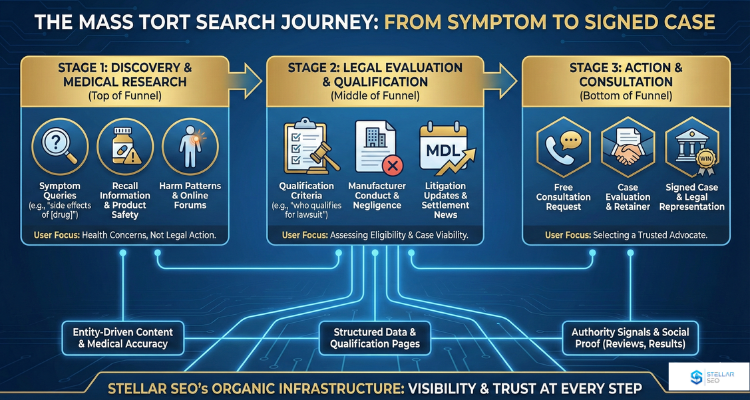
People affected by unsafe drugs, defective devices, or toxic exposure begin their research with questions about their own health, not legal rights. Their first searches revolve around symptoms, clinical findings, recall notices, and whether others are reporting similar problems. As they gather information, their queries shift toward qualification criteria, manufacturer conduct, and updates from federal agencies or MDL activity.
This progression creates clear intent signals. Search patterns move from medical discovery to legal evaluation, and each stage produces consistent keyword clusters with high search volume. Queries such as “is my device recalled,” “side effects linked to [drug],” or “cancer linked to [chemical] exposure” reveal early-stage concern. Questions like “who qualifies for a lawsuit” or “MDL status update” signal escalating interest and a higher chance of legal action.
When your pages address these stages in the order people search, your firm becomes the resource they rely on for clarity. Visitors respond to accurate, plain-language explanations backed by medical and regulatory entities they recognize. Internal links guide them from symptom-level questions to qualification details, settlement expectations, and ultimately a free consultation. This structure mirrors their decision path and positions your firm as the logical next step when they are ready to speak with an attorney.
Mass Tort Claims: Build Pages That Qualify and Convert
A claims page has one job: to help visitors quickly and confidently determine whether their circumstances meet the criteria for an active mass tort. People arrive with questions about harm, exposure, and eligibility, so the page must deliver direct answers without forcing them to sort through legal theory or long narratives.
An effective claims page starts by establishing what the drug, device, or chemical is and why it presents a risk. It then breaks down the specific injuries associated with that risk, citing the medical entities or scientific findings that support the connection. Clear qualification criteria follow next, outlining who is likely eligible, what factors strengthen a claim, and what situations typically fall outside the scope. This sets proper expectations and keeps unqualified leads from clogging intake.
Strong claims pages also guide the visitor through what happens after they qualify. Filing steps, required documentation, and timing considerations help people understand the path ahead. When updates exist, such as MDL consolidation or recent motions, they belong in a designated update section that signals the case is being actively monitored.
Every mass tort topic deserves its own landing page, and each should naturally link to deeper resources on injuries, exposure history, and corporate conduct. This structure allows visitors to navigate supporting material without confusion and enables search engines to recognize the depth of your coverage. When the flow is precise and the information is easy to process, more visitors transition from research to a free consultation.
How We Build Authority Content at Mass Tort Scale
Authority content is not simply long articles or keyword-heavy pages. It is a structured, entity-aligned system designed to reflect medical accuracy, legal context, and the user’s path from first symptom to claim filing.
Our Authority Content System includes:
- A dedicated hub page for each tort
- Subpages covering injuries, medical mechanisms, exposure pathways, corporate conduct, and recall history
- MDL updates and litigation movement pages
- Settlement expectation summaries
- FAQs tied to real search queries
- Clear qualification and next-step guidance
Each page builds upon the others. The structure signals to search engines that your firm has comprehensive coverage of every issue a claimant might research. As this system expands, rankings rise faster, supporting new torts without rebuilding from scratch.
Create Content That Attracts Potential Mass Tort Clients
Mass tort content works when it provides clarity as people begin piecing together what is happening to them. They are not looking for legal arguments. They want to understand symptoms, exposure history, manufacturer behavior, and whether others are reporting the same harm. Your content must answer those questions accurately and transparently.
A strong content strategy includes pages that expand beyond the main claim page. Educational guides, medical explanations, timelines of corporate conduct, recall summaries, and ongoing litigation updates all support the research path visitors take. These pieces establish your authority long before someone is ready to speak with a lawyer and help search engines understand the depth of your coverage on each mass tort topic.
Different content formats play various roles. Long-form guides build authority. Short explanations and FAQs help people move quickly to the information they need. Case summaries, expert commentary, and simple video explainers increase trust and keep visitors engaged. As this library grows, it produces stronger organic visibility, earns referral traffic from authoritative websites, and reinforces your position in competitive mass tort queries.
Landing Pages for Mass Tort Services
Landing pages introduce each mass tort case type and guide visitors toward a clear decision. These are not educational hubs; they are controlled entry points that communicate the essentials and direct people to the next step with minimal friction.
A strong landing page gives a clear snapshot of the issue: what went wrong, who is affected, and why legal action may be available. It presents injury information, qualification signals, and exposure pathways in an easy-to-scan, easy-to-understand format. Visitors should not have to hunt for deadlines or filing requirements, and calls to action should be visible wherever someone might decide they are ready for help.
The technical and structural elements of these pages matter just as much as the content. Pages must load quickly, work cleanly on mobile devices, and connect naturally to supporting pages about injuries, corporate behavior, and litigation progress. When design and content work together, landing pages convert more visitors into qualified consultations and help search engines understand the hierarchy of your mass tort site.
Website Optimization for Mass Tort Law Firms
Website optimization lays the foundation for your mass tort content. Search engines need a clean site structure that they can crawl easily, and users need a smooth experience that leads them toward a consultation.
A well-optimized site makes it easy to move between practice areas, mass tort topics, and qualification pages. Fast page loading speed prevents drop-offs, especially on mobile devices. Straightforward navigation, accurate metadata, structured data, readable headings, and simple forms all support better performance.
When your site is optimized, you can scale into new mass tort issues without sacrificing clarity or stability. Each new page fits naturally into the structure, which strengthens rankings and makes it easier for visitors to complete a free consultation.
Link Building and Off-Page Authority Signals
Off-page SEO strengthens your mass tort visibility by proving that trusted sources recognize your expertise. Links from reputable legal websites, medical publishers, legal directories, and major news outlets show search engines that your firm is credible.
Authority grows when you appear in legal or medical commentary, contribute to industry discussions, or collaborate with subject-matter experts. Consistent profiles across legal directories support your reputation, and steady social media engagement helps amplify your key content.
When multiple authoritative websites reference your work, search engines treat you as a reliable resource. This leads to better rankings for high-value mass tort keywords and attracts more clients to your firm.
Understanding Your Target Audience
Mass tort clients rarely start with legal searches. They begin with symptoms, product problems, contamination concerns, or news about corporate negligence. They want answers that are easy to understand and directly address what they are experiencing.
Keyword Research Uncovers Their Journey
Understanding these motivations shapes how you write and organize content. Your pages should acknowledge their concerns, give clear explanations, and provide actionable steps. This creates trust and keeps people engaged longer.
When your content speaks directly to the questions your audience is already asking, bounce rates drop, engagement increases, and more visitors feel confident reaching out to your firm for help.
How Topical Authority Determines Who Wins National Mass Tort Rankings
Search engines reward websites that demonstrate complete coverage of a topic. In mass tort SEO, this means understanding how medical, legal, and scientific concepts connect.
Our Topical Authority System uses:
- Centralized landing pages for each tort
- Supporting clusters for symptoms, injuries, exposure, recalls, and manufacturer history
- Internal link pathways that guide users from research to qualification
- Structured subtopics tied to FDA, EPA, CDC, NIOSH, and MDL entities
- Content expansion schedules aligned with litigation updates
This system gives your site a clear hierarchy. It shows search engines that your firm understands the full scope of each tort. As a result, new pages rank faster, and your visibility expands as the tort evolves.
Competitor Analysis for Mass Tort SEO
Competitor analysis reveals which other firms rank for high-value searches and the strategies they use to dominate them. Studying their structure, content depth, and link profiles shows where you can outperform them.
Tools like Ahrefs, SEMrush, and Google Search Console provide insight into keyword gaps, backlink strength, and ranking opportunities. By understanding these patterns, you can target the topics clients care about most and create stronger, more complete resources.
This approach lets you build authority intentionally, page by page, instead of passively reacting to the market.
Social Proof and Reviews
Social proof plays a significant role in how potential mass tort clients decide which firm to contact. People facing serious health issues or corporate negligence want reassurance that others have trusted you and had a positive experience with you. Testimonials, case results, media mentions, and professional recognition give visitors the confidence to take the next step.
These elements work best when they appear naturally within your most important pages. When someone reads a detailed explanation of their mass tort issue and immediately sees a real client describing how your firm helped them, it reinforces trust at the exact moment they are ready to act. Specific, concise reviews are more persuasive than general statements, and regularly updating these sections reminds potential clients that your experience includes current mass tort litigation, not just past work.
Placing social proof at key points in your landing pages, practice pages, and contact paths ensures that credibility supports the entire user journey. This helps reduce hesitation and increases the likelihood that visitors will initiate a free consultation.
EEAT for Mass Tort Websites
Mass tort content falls under topics that affect health, safety, and legal outcomes, so search engines evaluate it with higher scrutiny. Your website must demonstrate Experience, Expertise, Authoritativeness, and Trustworthiness throughout its structure and content.
Experience comes through when you reference real case involvement, relevant legal work, and clear histories of handling mass tort issues. Expertise is reflected in accurate explanations of injuries, medical terms, and litigation details. Authoritativeness develops when external websites, legal directories, and reputable publications recognize your firm. Trustworthiness is communicated through secure website architecture, transparent contact information, clear privacy policies, and honest descriptions of the claims process.
EEAT strengthens your entire SEO framework. When visitors stay longer, interact with your pages, and choose to contact your firm, search engines see your site as a reliable resource. Strong EEAT signals help you rank for high-volume mass tort topics and maintain visibility as new claims develop.
Technical SEO for Mass Tort Websites
Technical SEO ensures your website is fast, accessible, and easy for search engines to crawl and index. Mass tort sites often grow quickly as new issues emerge and more landing pages are added. If the technical foundation is weak, this growth leads to slow performance, broken navigation, and indexing problems that limit your visibility.
A technically sound website loads quickly on all devices, especially mobile. It uses a clean URL structure, compressed images, and stable hosting. Security is equally essential. HTTPS and proper certificates protect personal data and signal credibility. A clear architecture allows search engines to crawl and categorize every page without difficulty, while XML sitemaps and structured data improve the accuracy of indexing and presentation in search results.
Technical SEO supports your content and authority signals by ensuring nothing interferes with visibility or user experience. As you expand into new mass tort topics, a strong technical setup allows you to scale without compromising performance or rankings.
Tracking Mass Tort SEO Performance
Tracking performance helps you understand which strategies bring potential clients to your site and which areas need refinement. Organic traffic growth, keyword rankings, time on page, and conversion rates are among the most reliable indicators of progress. Referral traffic from authoritative websites and legal directories also indicates whether your off page SEO is delivering results.
Google Search Console provides data about impressions, clicks, and indexing status. Analytics tools reveal how visitors move through your site and which pages lead most often to free consultation requests. Observing this behavior helps you identify high-performing content, fix bottlenecks, and strengthen internal linking.
Effective tracking allows you to adjust your strategy as new mass tort issues arise or as competitive pressure shifts. Firms that monitor their metrics consistently achieve faster improvements and generate more qualified mass tort leads.
Why Mass Tort SEO Must Now Account for AI Search
AI systems are changing how people discover legal information. Many early-stage queries never reach Google because users are getting answers from AI tools.
A modern mass tort SEO strategy must account for:
- AI summary extraction
- Entity clarity across all pages
- Answer formatting optimized for AI retrieval
- Clean, link-light capsules with direct explanations
- Structured content blocks that AI models can interpret without ambiguity
Our campaigns integrate AI visibility testing so your firm appears in both traditional search and emerging AI-driven discovery paths. Firms that adapt now will control the next generation of mass tort visibility.
Build a Dominant Mass Tort SEO Campaign
Mass tort ranking is not won with generic content or surface-level search engine optimization. It is won with structured authority, medically accurate content, and a link acquisition strategy engineered for national competition. That is the system we use to help firms secure top-three positions across the most competitive torts in the country.
If your law firm wants earlier visibility, higher qualification rates, and a predictable flow of new cases, we can build the framework to get you there. We specialize in SEO and link building for personal injury and mass tort attorneys.
Schedule a consultation to see how our Authority Content System and Authority Signal Framework help mass tort firms dominate national search results.
Law Firm SEO Case Studies
FAQs
How long does mass tort SEO take to produce results?
Mass tort SEO generally takes three to six months to show movement for new campaigns, with stronger results appearing as topical authority and link acquisition compound. Timelines vary based on competition, content depth, and how well your site already supports large-scale tort coverage.
What type of content attracts the highest quality mass tort clients?
High-quality mass tort leads come from content that explains symptoms, injuries, exposure pathways, and qualification criteria in plain language. People search for clarity, not legal jargon, so relevant content that answers their medical and legal questions earns trust quickly and drives conversions.
Why is site structure so important for mass tort SEO?
A logical site structure helps search engines interpret your expertise across symptoms, injuries, exposure, recalls, and qualification pages. When pages are grouped cleanly and supported by internal links, your search visibility improves, and each new page ranks faster.
How do law firms build authority for competitive mass tort keywords?
Authority grows through medically accurate content, consistent on-page SEO, structured topical clusters, and links from authoritative legal and medical websites. These signals show search engines your firm is a trusted resource, which improves rankings for competitive national terms.
Why is technical SEO essential for mass tort websites?
Technical aspects such as fast load times, mobile performance, clean URLs, and crawlable architecture ensure your pages index correctly and scale as you publish new tort content. Strong technical foundations prevent ranking loss and improve user experience.
What separates a strong mass tort SEO campaign from most mass tort lawyers’ efforts?
Most mass tort lawyers publish surface-level pages that lack depth, a structured hierarchy, or authority signals. Strong campaigns use a planned content system, clear entity alignment, and targeted link acquisition to compete nationally and attract higher-value prospective clients.
How does creating valuable content improve mass tort case intake?
Creating valuable content that mirrors real search behavior keeps visitors on your site longer and helps them determine whether they qualify. As trust increases, contact rates rise, and your firm attracts more quality mass tort clients.
Why do law firms need ongoing SEO efforts for mass tort cases?
Mass tort litigation evolves as recalls, MDL updates, and scientific findings change. Ongoing SEO efforts ensure your content stays accurate, your rankings remain stable, and your firm remains visible when search volume spikes.
How do I know if my firm needs a more advanced mass tort SEO strategy?
You need an upgraded strategy when your mass tort pages fail to rank for symptom queries, qualification terms, or MDL updates. If competitors consistently outrank you despite similar content, the issue is usually weak authority signals, poor internal structure, or a lack of medically aligned content depth. These problems require a scalable framework rather than isolated page edits.