







Executive Summary
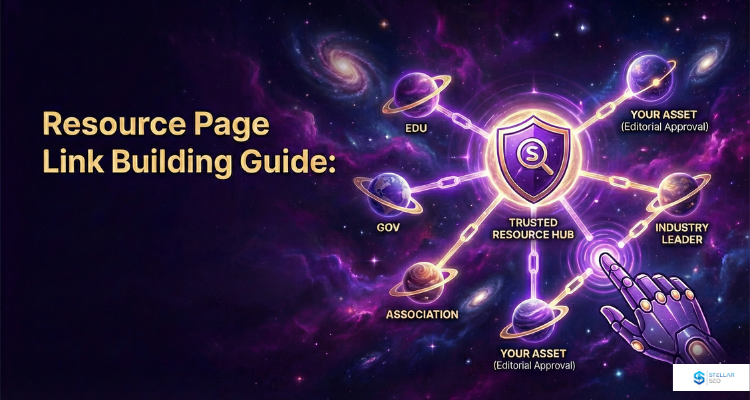
Resource page link building works when you target curated resource pages that are maintained by real editors who add links based on usefulness, relevance, and credibility.
At Stellar SEO, we use resource pages to reinforce topical authority and validate entity relationships, so your company appears more frequently in Google and AI search results.
Resource Page Link Building Guide
Most teams treat resource page link building like a volume game. They scrape lists, blast templates, and hope a curator adds them. That approach still lands occasional wins, but it rarely produces lasting authority.
Instead of reverting to the “spray and pray” method, treat resource page link building as if you’re seeking editorial approval.
You are not “asking for a backlink”; you are getting your asset accepted as a legitimate citation within a curated set of helpful links that a real human maintains for a real reason.
If you want a repeatable system, this draft covers how to build it, how to qualify relevant resource pages, and how to run outreach like a professional operator instead of a spammer.
What a resource page is and why it can move rankings
A resource page is a curated hub that links readers to the best references on a topic. It is usually maintained by a school, association, nonprofit, publisher, or specialist brand that wants to help its audience navigate a subject.
Done correctly, these pages send qualified visitors, reinforce topical alignment, and create long-lived endorsements. Done poorly, you end up on junk lists that never rank, never get crawled, and never help.
This is why not all resource pages are worth your time.
The value filter that separates winners from time-wasters
Before you pitch anything, you need to qualify what “good” looks like.
A typical resource page that performs well has a clear theme, a clean structure, a visible editor or curator, and curated outbound references that make sense to readers. A dead one looks like an abandoned directory.
Here is what you are really hunting for:
- high quality resource pages with editorial intent
- authoritative websites that are topically aligned with your niche
- a manageable number of outbound links that still leaves room for additions
- a reason your asset becomes a valuable resource for the page’s readers
If the page is maintained, ranks for something, and is clearly built for humans, it is in play.
Case Study
Using Resource Pages to Earn Hundreds of Geo-Relevant Links for Pet-Friendly Housing Pages
We executed a resource page link building campaign for Apartment Guide and Rent.com with the goal of strengthening authority for city-level pet-friendly housing pages.
Instead of pitching content, we positioned the pet-friendly housing search filter as a practical community resource for pet owners. For each city, we contacted veterinarians, animal shelters, rescues, and pet adoption organizations that already maintained local resource pages.
The outreach focused on one idea. People who adopt pets often struggle to find rentals that accept pets. Linking to a city-specific pet-friendly housing tool directly supported these organizations’ missions.
Because the asset was functional and genuinely helpful, not promotional, acceptance rates were high. Links were placed on curated resource pages maintained by trusted local organizations.
Results included:
- Hundreds of geo-relevant links
- Placements from topically and locally relevant pet organizations
- Direct authority reinforcement to city-level housing pages
- Stable links on pages that continue to accumulate trust
This campaign demonstrates how resource page link building works best when a functional asset is aligned with real community needs rather than forced into generic content placements.
How to identify targets without wasting hours
Your goal is to build a pipeline of potential resource pages and then narrow it down to the right ones.
Start with keyword research tied to your target audience, then build a prospecting method that is more precise than “search and scroll.”
Use advanced search operators to find pages that are already curated. Pair them with a resources keyword and a modifier that maps to your niche.
For example, you can find resource pages by searching topics plus “resources,” “useful links,” “recommended,” or “help.” The point is to locate pages that already behave like curators.
From there, you will identify resource pages that match your niche, your asset type, and your authority level. Then you will find relevant pages that are not just thematically aligned but also positioned to drive traffic and transfer trust.
When you run these queries, pay attention to the Google search results layout and what consistently appears. You are reverse-engineering what Google already treats as credible.
What to pitch and what not to pitch
Resource curators do not want thin commercial content. They want references that genuinely help people.
That means your pitch asset needs real utility. Common winners include:
- original blog posts with uncommon insights
- a visually appealing guide that actually teaches something
- a checklist, template, or calculator that functions like an interactive tool
- a directory that curates useful industry resources and updates over time
You can also pitch content that sits outside your money pages. In many cases, a supporting asset is easier to place than service pages, then you use internal linking to route authority where you need it, including your internal resources.
Think like a curator. If the page owner is trying to help readers, does your asset improve the page?
The selection criteria Stellar teams use
Metrics matter, but only in context. You can use SEO metrics as guardrails, not as the strategy.
Look at:
- domain rating and domain authority as quick filters, not decision makers
- whether the page gets organic traffic or ranks for any non-brand queries
- whether the site has a real editorial footprint and credible citations
- whether your asset fits naturally among the relevant links already listed
This is also where you avoid obvious pitfalls like link farms. Our team uses a 27-point screening criterion to consistently deliver high-impact links for our clients.
The outreach angle that actually works
You are pitching people, not algorithms. Some pages list a curator, some list a department email, and some hide behind a contact form. Either way, your job is to contact resource page owners with a value-first message.
Avoid “Can you add my link?” and lead with why the resource improves the page and helps their readers. Treat it like an editorial recommendation.
A clean outreach message covers:
- why your asset is topically aligned
- what gap it fills in their existing list
- why it belongs next to their related resources
- the exact suggested link placement, so they do not need to guess
This can be done with professional outreach emails that are short, specific, and easy to act on.
When possible, reference something real on their page. Curators respond to people who actually looked.
Where broken links fit and how to use them correctly
One of the most reliable entry points is when a curator has broken links on their page. Fixing problems is easier than asking for favors.
This is where broken link building can be folded into the workflow without becoming your entire strategy. You are not “doing broken link building,” you are improving a living page.
If you find a dead citation, you can offer your asset as the best replacement, or suggest an alternative if yours is not the perfect fit. That builds trust quickly and often leads to additional placements.
A simple workflow for execution at scale
This is the backbone that link builders and link building teams can follow without turning it into spam.
- Build a prospect list and categorize targets as relevant pages or “maybe later”
- Validate each target’s intent and quality, then flag any obvious editorial patterns.
- Match each target with the best pitch asset, including existing resources you already have
- Send outreach and track outcomes as part of a disciplined link building process.
- Follow up, improve your assets, and keep pushing toward a successful resource placement.
This is also how you improve your conversion rates over time. Your strategy gets smarter every round.
How to measure what actually matters
A resource placement is not just “a backlink.” It is a trust-building endorsement that can help stabilize rankings and build topic authority.
Track:
- placement rate across your link building efforts
- ranking movement for the cluster, not just a single keyword
- referral visits from the source and engagement quality
- whether the placement helps close a competitor gap in your link building campaign
If the page ranks, gets crawled, and stays maintained, you are accumulating real value.
Important nuance about links and placement types
Not every resource hub behaves the same. You will see curated guides, university references, association lists, and listicle resource pages that are closer to editorial roundups.
All of them can work, but the standard stays the same. The page must be maintained, relevant, and credible.
When you earn a resource page link, you are typically getting placed among curated citations, which tends to stay live for longer than a transient placement on other websites that constantly rotate content.
This is why resource hubs can be a powerful link building strategy when you execute them like an editorial operator.
Where Stellar SEO fits
If you want to do this internally, the system above works, but it requires discipline. If you want it done for you, that is where a proven link building agency adds leverage.
We focus on earning high quality links that align with topical authority goals, not vanity placements.
If you have ever seen low-effort pitches discussed in Search Engine Land, you already know what to avoid. The bar is higher now, and curators have less patience for noise.
Final note on scale and follow-through
You will not land everything you pitch. The difference is what you do after the first pass.
Revisit your list, refine your assets, and work the remaining pages that are truly worth pursuing. Over time, you build a portfolio of curated citations that reinforces authority.
That is how building links through curated resources becomes sustainable.
And if you want to take it one step further, build a dedicated link building resource on your own website that curators can confidently reference. That asset becomes your leverage point for resource link building, increases acceptance rates, and creates more valuable links over time.
If you need a working definition to keep your team aligned, here it is:
Resource page link building works when your assets earn real editorial inclusion, and a resource link is earned when you improve a curator’s list with genuinely relevant content.
Once you can consistently find relevant resource pages, your acquisition engine stops being a matter of luck and becomes a repeatable system.
Frequently Asked Questions
Do resource page links need to be dofollow to provide value
No. While dofollow links still pass direct PageRank, nofollow links from authoritative resource pages carry real value in modern search.
Search engines and AI systems increasingly prioritize context and credibility, not just link attributes. A link from a trusted resource hub signals that your brand belongs in that topical ecosystem. Even when a link is marked nofollow, the contextual mention and association still reinforce authority and recognition.
In practice, some of the strongest resource placements we earn are nofollow, and they still correlate with ranking stability and improved visibility.
How do resource links impact Google’s Knowledge Graph
Resource pages often group your site alongside established organizations in the same space. That co-occurrence matters.
When your brand appears next to trusted institutions, associations, or recognized local entities, it reinforces how search engines understand what you represent and where you belong. These associations help strengthen entity relationships and reduce ambiguity around your brand.
Over time, this supports stronger classification, better topical trust, and eligibility for competitive rankings and AI-generated summaries.
Are resource page links still effective in 2026
Yes, but only when the page has real editorial oversight.
Search engines increasingly reward links that exist within a meaningful context and serve an actual reader. A single link on a maintained, high-quality resource page can outperform dozens of links from unmoderated directories or templated placements.
If the page is curated, relevant, and actively maintained, resource links remain one of the most useful link types available.
How do you tell if a resource page is dead or abandoned
Start with basic signals. Look for recent updates, working links, and signs of ongoing maintenance.
Pages filled with broken links, outdated formatting, or references that have not been touched in years are usually crawled infrequently and provide little value. We prioritize resource pages that rank for their own keywords, receive traffic, and clearly have someone responsible for keeping them current.
If no one is maintaining the page, it is not worth pursuing.
What is a realistic success rate for resource page outreach
In a highly targeted campaign using a genuinely valuable asset, a five to ten percent placement rate is realistic.
Generic content produces far lower results. Resource page outreach succeeds when the asset clearly improves the page for its audience. Success is not measured by how many emails go out, but by the quality and durability of the placements earned.
One strong placement on a trusted resource page is worth more than dozens of low-quality wins.