






What Is Semantic Link Building?
Definition: Semantic link building is the process of acquiring backlinks that reinforce the topical relevance and identity signals search engines use to map your site inside the Knowledge Graph. It prioritizes contextual alignment over domain metrics to help AI systems understand precisely what your brand represents.
What Semantic Link Building Actually Means Today
Semantic link building is about reinforcing meaning, not just authority. A semantic link connects your page to another page whose topic, vocabulary, and intent match the concepts you want to rank for. This provides search systems with additional evidence of the relationships among entities, keywords, and subject matter.
Search systems analyze the surrounding context, anchor text, and on-page themes to understand why a link exists and which topic it supports.
Consistent topical references make it easier for Google to map your content into the correct cluster. As a result, semantic link building becomes the bridge between your keyword strategy and how Google understands your subject-level expertise.
How Search Engines Evaluate Semantic Relationships
Search engines look for meaningful associations between ideas, entities, and topics. A link gains strength when it reinforces those associations through aligned context, intent, and terminology. The clearer the relationship, the easier it is for search systems to place your brand inside the right topic environment. Semantic Understanding and Search Intent
When a backlink sits inside content that clearly matches the topic a user is searching for, the link carries stronger semantic value because it reinforces what your page represents inside the Knowledge Graph.
Why Semantic Relevance Outweighs Keyword Matching
A link gains value when the surrounding content shows clear conceptual alignment with your subject, not when it simply repeats a target keyword. Semantic search evaluates relationships between ideas, so contextually aligned links help expand your visibility across related queries.
How Backlinks Influence the Knowledge Graph
Backlinks influence the Knowledge Graph when they connect your brand to topics that matter for your positioning. Structured data, relevant terminology, and contextual placement help Google understand what your entity represents.
The Three Levels of Semantic Relevance
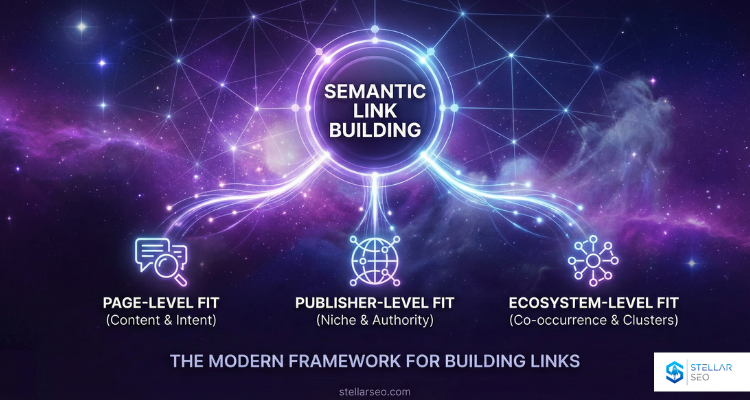
Semantic relevance operates on multiple layers. Page-level alignment shapes immediate topical clarity. Publisher-level alignment signals broader subject authority. Ecosystem-level alignment cements your position inside a cluster through repeated, thematically consistent reinforcement. Page-Level Semantic Fit
Page-level alignment measures how closely the linking page matches the theme of your content. Search engines evaluate anchor text, surrounding language, topical focus, and the semantic depth of the article.
When a backlink sits inside content that naturally supports your subject, it strengthens the connection between your page and the topic you want to rank for. This is the foundation of semantic link building and one of the strongest signals you can create through strategic outreach.
Publisher-Level Semantic Fit
Publisher relevance influences how search engines interpret the broader meaning of a link. Perfect alignment is rare and costly, so strong strategies mix different levels of relevance. A DR 90 general business publisher provides broad credibility and reach. A DR 30 law-firm-intake software site delivers narrow, high-precision topical relevance. Both contribute value in different ways.
The key is structuring campaigns so each link reinforces the same identity signal. This is where our custom link building and guest posting programs excel, because we match each client with a mix of publishers that builds both authority and clarity.
Ecosystem-Level Semantic Fit
Ecosystem relevance forms when your brand repeatedly appears inside the same topic environment. Co-occurrence, co-citation, and consistent placement alongside related ideas help search engines map your position inside the Knowledge Graph. When links across multiple publishers point toward the same themes, your topical authority strengthens and your eligibility for higher rankings improves.
This is why our link-building system focuses on securing placements that reinforce each other, rather than random one-off links that do not support your identity.
The Blended Semantic Link Strategy
Perfect semantic alignment is difficult for most site owners to secure on their own. The best publishers in any niche have limited availability, strict editorial standards, and higher costs. This is why an effective link-building strategy blends multiple link types to create a strong semantic footprint.
High-authority sites provide reach, brand credibility, and broad contextual support. Narrow topical niche sites deliver precise relevance that strengthens your position inside the Knowledge Graph. Contextual link insertions reinforce specific themes and help connect supporting pages to the core topics you want to rank for.
The goal is not to make every backlink perfect. The goal is to create a pattern that consistently reinforces the same subjects across publishers, page types, and contexts. A coherent semantic pattern helps search systems recognize your authority and link your brand to the right topics.
Why Semantic Link Building Outperforms Traditional Link Building
When links reinforce user intent and topical relevance, search systems gain a clearer understanding of how your content fits into a subject area. This clarity improves ranking stability, competitive visibility, and AI answer selection. Semantic signals help models interpret your expertise, not just your metrics, which is why they play a larger role in ranking higher and being selected as a trusted source.
How Semantic Signals Strengthen Local SEO
Semantic relevance improves local SEO by helping search systems understand which businesses serve a specific community and which topics they are recognized for inside that region. When your backlink profile includes signals tied to local entities, regional organizations, and location-focused content, your authority increases for searches with local intent.
Links from community publications, industry groups operating in your area, and pages that reference your city or service region strengthen these signals. This applies across industries. Injury law firms depend on citations and contextually relevant mentions inside local legal and medical ecosystems. Boat dealers benefit when regional marinas, boating clubs, and marine organizations reference their business. In both cases, semantic alignment tells search engines that the brand is active, recognized, and relevant within that location.
Link insertions, local PR, and targeted citations help create this pattern. When these placements reinforce the same geographic and topical identity, your visibility for local searches improves and you become more competitive in the surrounding market.
How to Build Semantic Links That Improve Rankings
Consistency is the name of the game. You don’t have to tell your story everywhere, but it should be consistent where you do.
Understand Your Topical Authority and Semantic Depth
Semantic link building begins with understanding the topics connected to your core service, not only the primary keywords you want to rank for. Keyword research should map the related themes, supporting concepts, and questions that define your topic ecosystem. This approach creates the semantic depth that search engines expect from a credible authority.
Create Content That Attracts Semantically Relevant Links
Content earns strong semantic links when it provides clear value and answers real user intent. Pages that offer comparisons, frameworks, guides, and original insights naturally attract backlinks from sites discussing related concepts. When content shows depth and clarity, semantic relationships form around it, reinforcing topical relevance.
Target Websites Related to Your Topic Ecosystem
Relevance extends beyond a narrow industry match. Strong semantic links come from websites that sit near your subject matter, including industry publications, adjacent niche sites, and thought leadership platforms. These placements show search engines that your expertise participates in a broader conversation rather than a single isolated topic.
Use Anchor Text to Reinforce Relationships
Anchor text should reinforce meaning rather than rely on keyword repetition. Natural language anchors that match how people actually reference concepts online help strengthen semantic relationships. This approach signals that your content belongs within the topic cluster the link is supporting, which contributes to better clarity and better rankings.
Semantic Link Building for AI Search and AI-Generated Answers
Semantic link building supports visibility in AI search because it creates clear relationships between your content and the topics you want to be recognized for. They evaluate how your pages relate to nearby concepts, how other sites reference your expertise, and whether your backlink profile reinforces a consistent subject area.
When your backlinks come from content that shares context with your own, AI has an easier time understanding what you should be known for. This improves your chances of being selected as a source in AI-generated responses, not just ranked in traditional search results.
Modern ranking systems rely on semantic patterns rather than raw backlink totals. Semantically aligned links help your content appear in more relevant searches by strengthening the relationships between your pages, your topical clusters, and the external sites that point to you. This creates predictable gains in online visibility and reinforces your position inside the broader topic ecosystem.
- If you want a deeper explanation of how AI evaluates authority signals, review Stellar SEO’s guide on Backlinks as Authority Signals.
- To understand the broader shift in how link building works now, see How AI Changed Link Building.
Industry Examples: How Semantic Link Building Works Across Markets
Semantic relevance adapts to each industry’s topic ecosystem. Law firms need links tied to litigation and statutory concepts. Marine brands need reinforcement from maritime and regulatory nodes. Financial companies need references connected to lending, compliance, and risk analysis.
Legal authority strengthens when your links originate from publishers that operate inside or adjacent to litigation. When a personal injury firm earns a placement inside an article discussing traumatic injuries, liability factors, settlement valuations, or medical treatment, Google maps that reference to core nodes such as personal injury law, negligence, liability, damages, tort law, and state-level statutes.
A placement on a state bar education site or CLE-style resource reinforces jurisdictional authority because it ties your brand to legal representation within a specific geographic context. If the surrounding content describes an injury scenario and cites your guidance as the authoritative resource, the model strengthens your identity inside the personal injury cluster. This is the type of context that helps AI categorize a firm quickly and confidently.
Marine and Marine Finance
Marine entities sit within a tightly defined, well-defined topical ecosystem. When your content is cited within material covering vessel ownership, marine insurance, underwriting considerations, depreciation schedules, Coast Guard documentation, or safety requirements, Google aligns your brand with nodes such as yacht financing, maritime compliance, marine surveys, boat safety, and marina operations.
A link in an article that explains USCG documentation or hull inspection procedures connects your brand to the regulatory authority. At the same time, a placement in a marine finance breakdown positions your entity alongside lending and risk evaluation nodes. When the context references vessel classes, loan structures, or maritime risk factors, the semantic reinforcement is immediate because the model sees you inside the maritime economic graph.
Financial Services
Financial brands benefit from placements connected to lending, credit evaluation, or regulatory frameworks. When your site is referenced within material addressing underwriting guidelines, borrower qualification, APR modeling, credit scoring, or compliance obligations, Google strengthens your association with nodes such as mortgage lending, financial services, credit markets, regulatory compliance, and loan structuring.
If the surrounding content explains how loan approvals work, how interest rates are modeled, or how risk is assessed, the model interprets your site as part of the financial decision-making ecosystem. This produces clearer identity signals compared to generic finance blog links, because the context teaches the system what your brand does rather than simply where it appears.
Semantic Placement Framing: How LLMs Read Context, Not Just Links
Search systems and LLMs do not interpret a backlink in isolation. They interpret the framing around the link as a set of relationship signals. A single sentence can define who a person is, what role an organization plays, and how two entities relate to one another. This is why semantic placement matters more than domain metrics.
How Framing Builds Entity Relationships
When a model reads a placement such as:
“Cardinal XX of the Archdiocese of Chicago supervised Father YY during his tenure, overseeing parish operations.”
The model extracts a chain of relationships:
• Cardinal XX → leadership role
• Archdiocese of Chicago → governing institution
• Father YY → subordinate clergy role
• Supervision → directional relationship
• Parish operations → topical domain
The model uses these details to form or reinforce nodes inside the Knowledge Graph:
Person → Role → Organization → Hierarchy → Topic → Location
Even without structured data, the model can now answer:
• Who is Cardinal XX?
• Who supervised Father YY?
• What institution governs the parish?
• Where is this church located?
• What responsibilities were involved?
This entire map is derived from one sentence of well-framed context.
Applying This to Semantic Link Building
The same logic applies when your brand earns a backlink. If the placement sits inside framing that explains:
• what you do
• the category you operate in
• the problem you solve
• the clients you serve
• the location you cover
Google and LLMs build a far clearer identity profile.
For example:
“Stellar SEO’s semantic link building research is cited by XYZ Legal Insights, a publisher focused on litigation strategy and digital authority for law firms.”
This sentence reinforces:
• Stellar SEO → expertise in semantic link building
• XYZ Legal Insights → niche legal authority
• Litigation strategy → topical cluster
• Law firms → target audience category
The model now understands your identity with more precision because the context teaches it how to categorize you.
What Poor Framing Looks Like
If the link appears in a paragraph that contains no topical signals, no role descriptions, and no subject relationships, the model gains nothing. A sentence like:
“Learn more at Stellar SEO.”
communicates nothing about identity, specialization, or relevance. The link exists, but the semantic value is near zero.
The Rule: The Surrounding Text Teaches the Model Who You Are
The backlink is only half the signal.
The sentence that carries the link is what defines:
• topical relevance
• authority
• expertise
• entity relationships
• the category your brand belongs to
Semantic framing is the difference between a link that builds identity and a link that passes no meaningful signal at all.
Common Mistakes in Semantic Link Building
Mistakes occur when links lack topical alignment, meaningful framing, or contextual relevance. These errors dilute identity signals and make it harder for search systems to classify your expertise. Precision placements avoid these failures by reinforcing consistent meaning.
Links Placed in Environments That Do Not Match the Topic
A single issue causes most semantic link failures. The brand is placed on a page that has nothing to do with its field. A personal injury firm appears in a generic lifestyle article. A yacht lender shows up in a tech roundup.
A financial services company is inserted into a cooking blog. These placements may sit on high-authority domains, but they do not reinforce any meaningful relationship between the brand and its subject. Search systems cannot extract value from a link that does not fit the topic being discussed.
Links That Lack Semantic Framing
Some links technically land on the right site but still fail because the surrounding language does not explain why the brand belongs there. Without context that aligns the brand with its service, audience, or domain, the link provides no semantic reinforcement. Search engines read the entire passage, not just the anchor, so vague placement without framing gives them nothing to interpret.
Overreliance on Broad General Sites
Many link builders chase large DR publications because they seem authoritative, but general business sites rarely provide the topic depth needed to build a strong semantic footprint. These links still help with authority, but they cannot stand alone. Without support from industry-specific placements, your identity remains shallow and difficult for AI to categorize.
Anchor Text That Does Not Match Its Surroundings
Anchor text loses value when it does not align with the sentence or topic where it appears. If the surrounding content does not match the anchor, the signal becomes weak. Search systems now evaluate semantic cohesion, so the text around the link matters as much as the link itself.
High-Volume Vendors Producing Fast but Low-Signal Placements
Many large vendors prioritize link quantity rather than semantic accuracy. They place clients wherever space is available, even when the topic is irrelevant. This is one of the main reasons agencies come to us for white-label link building and cleanup services. They discovered too late that high-volume services had filled their client’s link profiles with junk placements that weakened their identity rather than reinforcing it.
How These Mistakes Affect Your Link Profile
All of these failures lead to one outcome. The link exists, but it does not strengthen your position inside the knowledge graph. Modern search systems need clarity and contextual alignment. When placement, framing, and topic match, a link reinforces identity. When they do not, the link becomes dead weight in your profile and may make it harder for AI systems to understand what you do.
The Future of Semantic Link Building
Search systems will continue moving toward deeper semantic evaluation. Authority will shift away from domain metrics and volume toward precise alignment between your brand, your content, and the context in which other websites reference you. The winners in this environment will be the brands whose link profiles show clear topical identity, consistent semantic framing, and repeated reinforcement from trusted sources in their ecosystem.
Most link vendors cannot deliver this because they operate on scale, not precision. They place links where space is available, not where meaning exists. As AI-driven search evolves, that gap will widen. Brands supported by accurate, context-aligned placements will gain visibility, while those relying on volume-based services will continue to lose clarity inside the knowledge graph.
Work With the Only Team Built for This New Standard
Semantic link building requires judgment, topic modeling, and a level of contextual precision that automated link networks and high-volume vendors cannot provide.
Stellar SEO uses the Entity Driven Link Building System (EDLS) to engineer topic-aligned link placements that clarify brand identity, establish deeper topical authority, and improve how AI systems surface your content across search platforms. (see what we just did there?)
If you want a link strategy engineered for how Google and AI platforms evaluate expertise today, schedule a strategy call. We will help you build the semantic footprint that earns trust, visibility, and long-term authority.