







When Google doesn’t trust you as much as your competitors, you lose.
In competitive legal, maritime, and regulated markets, ranking failures rarely come from missing keywords, thin content, or weak design. Those are surface explanations. The real failure happens earlier, at the point where Google attempts to resolve who you are and what you are allowed to rank for.
Search engines no longer treat firms as collections of pages. They treat them as entities. Each entity is evaluated for scope, credibility, and consistency before rankings are ever stabilized. That evaluation pulls from your site, but it is shaped just as heavily by external descriptions, citations, editorial references, profiles, bios, and how independent sources summarize your role.
When those signals align, Google commits. When they do not, Google withholds visibility.
That withholding does not look dramatic. There is no penalty. Pages still index. Rankings still move. But they never lock. Practice areas struggle to expand. Competitors with objectively weaker operations appear above you because their identity resolves faster and with less contradiction.
This is why firms with fewer pages, fewer links, and less impressive outcomes often dominate search results. Google is not rewarding quality. It is avoiding ambiguity.
Once an entity reaches a confidence threshold at which its definition is consistently reinforced across sources, the system stops hesitating. Indexing accelerates. Rankings stabilize. Visibility extends into adjacent services without constant intervention. The entity becomes low-risk to surface.
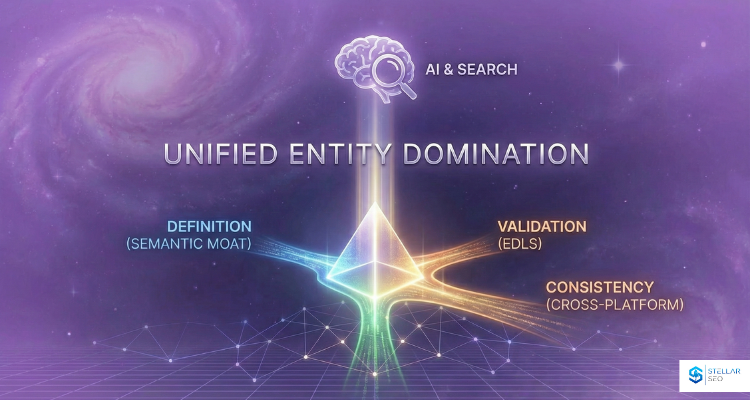
Most firms never reach that state. Not because they lack authority, but because their signals were built independently, over time, without a unifying structure. Unified Entity Domination for AI & Search exists to eliminate that ambiguity and force resolution.
What Unified Entity Domination for AI & Search Means
| Level | Pillar 1: Semantic Moat (Content & Visuals) | Pillar 2: Cross-Platform (Brand Signal) | Pillar 3: Entity-Driven Link Building (EDLB) |
| L1: Foundation | Core Service Pages & “Who We Are” | NAP Consistency (GMB, Apple, Bing) | Foundational Links (Directories, Associations) |
| L2: Expansion | Topical Clusters (The “Why”) | Social Profiles & Industry Platforms | Contextual Niche Edits / Guest Posts |
| L3: Authority | VEO (Visual/Video) & Experience | Brand Narrative & Reputation | Strategic Partnerships (3-Way Swaps) |
| L4: Technical | Nested Schema Architecture | Identity Resolution (sameAs Mesh) |
Behavioral Validation (User Signals) |
Unified Entity Domination for AI & Search describes the point at which search engines and AI systems consistently surface your firm because every major signal supports the same authoritative identity.
The system was built for environments where credibility must be proven repeatedly rather than assumed. That includes personal injury and mass tort law firms, marine law and marine-focused businesses, financial services, real estate, and other regulated or YMYL industries.
In these markets, Google commits to entities it understands and withholds visibility from those it does not.
Unified Entity Domination exists to force that clarity.
But Does It Work?
Yes, when you solve the problem at the source, it works.
We applied this framework for a national nursing home injury law firm competing against DR 80–90 publishers and state-level personal injury firms.
Over 14 months, organic traffic increased from 6,900 to 34,700 monthly visitors. That growth did not come from publishing more content. It came from aligning the firm’s on-site definition with off-site validation across high-trust legal topics.
The full case study is available here:
https://stellarseo.com/nursing-home-injury-lawyer-seo-case-study/
This structure produces results in other regulated industries where third-party confirmation determines visibility, including finance and lending.
The System Behind Unified Entity Domination
Google’s Knowledge Graph (and LLMs) both struggle with uncertainty.
When Google cannot clearly resolve what an entity is, whether that entity is trusted, or whether its identity holds up across the web, visibility stalls. Not because something is broken, but because the system will not commit.
Unified Entity Domination exists to remove that hesitation.
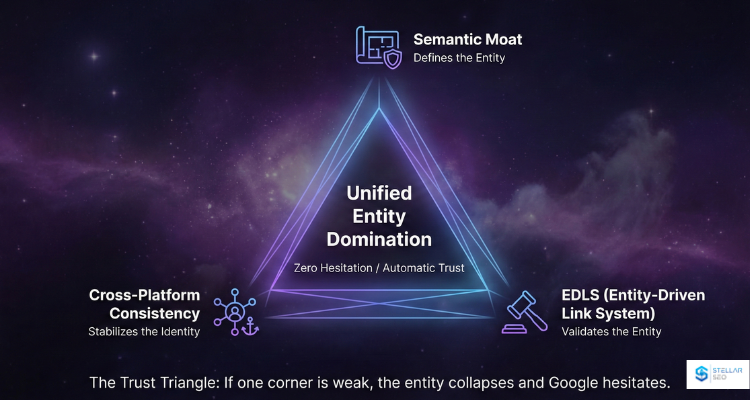
Google needs three things before it commits to visibility: a clear definition of what you are allowed to rank for, independent confirmation that others recognize that expertise, and the same identity reinforced everywhere it looks without contradiction.
These are the conditions Google uses to decide whether an entity is consistently safe to surface, not theories. The system below is built to meet those conditions directly.
Semantic Moat
Defining the Entity
You cannot rank as an authority if you have not clearly defined what you are, what you do, and where your expertise stops.
The Semantic Moat converts real-world expertise into a structured format that Google can interpret unambiguously. It establishes what your firm actually does, which topics legitimately belong to you, and where your authority ends.
For law firms, this begins with a primary entity, such as “Chicago personal injury lawyer,” and then expands into related practice areas within the same legal scope. That may include auto accidents, truck crashes, nursing home abuse, wrongful death, maritime injury claims, or mass tort litigation.
The problem is structural inconsistency, not covering multiple practice areas.
When some areas are deeply reinforced, and others are thin, fragmented, or organized differently, Google does not partially trust the entity. It slows down and withholds visibility.
The Semantic Moat removes that friction through consistent content architecture, entity-aligned practice clusters, jurisdiction and regulatory references, internal linking patterns, and paragraph-level reinforcement that matches how people actually search.
- Each page reinforces the same identity.
- Each section supports the same scope of authority.
- Each paragraph contributes to a single narrative.
Think of it like a courtroom. If five attorneys represent you, but they all tell a slightly different story, the jury stops trusting you. Accuracy doesn’t matter if the narrative is confused.
Google responds the same way.
The Semantic Moat defines precisely what Google is being asked to trust.
Entity-Driven Link Building System (EDLS)
Validating the Entity
Once your entity is defined, Google looks outside your site to confirm it.
Search engines do not accept self-assertion. They cross-reference your on-site definition against independent sources and measure agreement, context, and consistency. This is where most SEO campaigns fail. Firms build links to an entity that Google still considers unclear.
EDLS exists to prevent that failure.
This system governs how editorial backlinks, citations, co-citations, anchor text, and surrounding context reinforce your identity across the web. It prioritizes relevance and alignment over volume, and context over surface-level metrics.
EDLS does not change what your firm is. It confirms it externally.
That confirmation comes from authoritative legal, maritime, financial, and industry publications, as well as trusted third-party platforms that describe your firm using the same scope, hierarchy, and language established on your site.
The right links build authority and trust, while validating your brand.
In competitive YMYL markets, independent confirmation carries more weight than anything a firm can claim about itself.
Cross-Platform Entity Consistency
Stabilizing the Identity
The final question Google asks is whether the identity holds up everywhere.
Search engines do not rely on a single source. They compare your website against Google Business Profiles, directories, attorney bios, social platforms, YouTube channels, press coverage, reviews, and third-party summaries. When those sources describe different versions of your firm, trust erodes.
Cross-platform entity consistency eliminates that erosion.
This system aligns categories, descriptions, and positioning across every major surface where your firm appears. Each reference reinforces the same identity instead of introducing noise.
Consistency stops authority from leaking out of the system.
How It Comes Together
Most firms treat SEO as a checklist. Content here. Links there. Profiles somewhere else.
Google evaluates entity consistency, not effort.
- The Semantic Moat defines the entity.
- EDLS validates it through independent agreement.
- Cross-platform consistency prevents contradiction.
When those three are aligned, Google stops second-guessing your firm. Rankings stabilize because the entity is stable. New practice areas gain visibility without friction. Authority compounds instead of resetting.
Search engines and AI systems reach the same conclusion for the same reason. Your firm becomes the cleanest match available, not the loudest one.
Why This Matters Now
Google is no longer ranking pages. It resolves entities and decides which ones are safe to surface repeatedly. AI Overviews, Gemini, ChatGPT, Perplexity, and modern ranking layers all inherit that same decision logic.
When your signals conflict, Google suppresses visibility and routes demand to the firm with the cleaner, more consistent identity.
For many firms, the problem is already present.
- The website defines one version of the firm.
- Links reinforce a different narrative.
- Profiles, citations, and third-party summaries describe something slightly different.
- Google detects the contradiction and defaults to the entity it already trusts more.
This is the current system, not a theoretical future shift. The margin for inconsistency is simply shrinking.
If your entity is not unmistakably clear, you are being filtered out.
Entity resolution, cross-source agreement, and trust thresholds now outweigh individual pages, keyword coverage, and raw link counts. That is why traditional SEO tactics stall while firms with cleaner entity signals continue to expand visibility.
Unified Entity Domination for AI & Search exists because this is how ranking decisions are made.
When definition, validation, and stabilization align, Google resolves the entity cleanly. Rankings stabilize. Visibility compounds. AI systems surface your firm because it represents the lowest-risk answer available.
Stop investing in disconnected SEO tasks.
Build an authority asset Google already recognizes, understands, and trusts.
Related Resources