








Executive Summary
Visibility now depends on whether a brand can support every question an AI system asks before it answers a user. Most sites fail because they optimize for isolated keywords rather than the reasoning behind modern search.
We solve this by mapping fan-out queries, publishing high-density content that resolves each branch of intent, and reinforcing those answers with aligned off-site validation. This turns fragmented content into a unified authority system that AI models repeatedly select, cite, and trust.
How Do Fan-Out Queries Impact SEO?
AI search evaluates authority across connected questions, not individual keywords.
Traditional SEO revolved around matching a single phrase to a page. If the wording aligned, the page ranked. That approach no longer reflects how Google ranks websites in 2026.
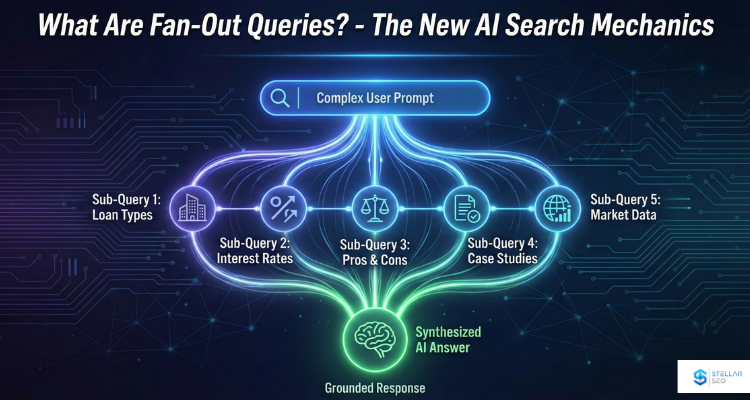
When a user submits a complex prompt to ChatGPT, Perplexity, or Gemini, the system expands the prompt into multiple related sub-queries and evaluates sources for each. This expansion is called query fan-out.
The Definition of Fan-Out Queries
Query fan-out is when an AI model breaks a single prompt into multiple sub-queries. The AI acts like a research assistant. It identifies the different parts of a user’s intent and runs several searches simultaneously to gather a complete answer.
If a user asks, “What is the best way to fund a commercial real estate deal?” the AI may fan that out into these sub-queries:
- Types of commercial real estate loans
- Current interest rates for SBA 504 loans
- Pros and cons of hard money lending
- Case studies of successful commercial syndication
The AI then gathers information from various sources for each sub-query and synthesizes them into one response. These sub-queries are the new version of keywords.
Coverage vs. Length: The Information Density Filter
A common mistake in AI SEO is assuming that longer content leads to better coverage. Recent research[1] into AI search filters suggests the opposite is often true. AI models like Gemini and GPT-4 use “grounding” to verify facts. They look for the most efficient, high-density answer to a specific sub-query.
If your page is 5,000 words long but only contains 500 words of actual “information gain” (new, unique data), the AI may filter it out. The model prefers atomic content segments. These are sections of text that stand on their own and provide a direct answer without unnecessary filler.
To rank for fan-out queries, you should focus on “Selection Rate Optimization.” This means making your answer so concise and data-rich that the AI cannot help but select it as the primary source for that specific branch of the search.
How Fan-Out Queries Build Your Semantic Moat
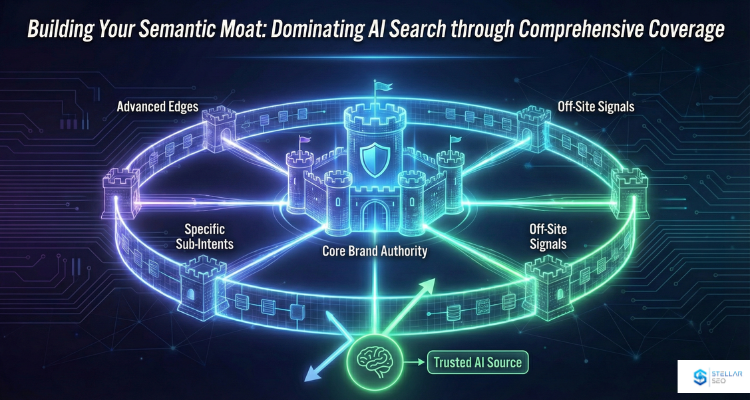
We have discussed the Semantic Moat as a way to protect your authority. Your moat is built by covering the “advanced edges” of a topic.
When you identify the fan-out queries associated with your core services, you can create content that answers every specific sub-intent.
By doing this, you ensure that no matter which “branch” of a query the AI follows, it finds your site. This turns your website into a high-confidence source of truth that the AI cannot ignore.
When you combine detailed topical coverage and information gain, you add value to both LLMs and people reading your site.
Off-Site Reinforcement: Validating Your Expertise
Good writing alone isn’t enough to rank for fan-out queries. The AI needs to verify that your site is a credible source for the answers you provide. This is where off-site reinforcement comes in.
Every external signal serves as a validation of your expertise.
- Link Building: High-authority links from industry sites tell the AI that other experts trust your data.
- Digital PR: Mentions in major publications confirm your brand as a recognized entity.
- Social Media and YouTube: Consistent messaging across these platforms provides the “social proof” that AI models use to gauge brand prominence.
Creating Content for Guest Posts and Link Placements
To win at the fan-out game, you should create guest posts and link placements that specifically target the fan-out queries you want to own.
Practical Example: Imagine you want to be the top source for “AI SEO services.”
- On-Site: You create a pillar page that answers the main query, and subpages that answer fan-out queries like “LLM-optimized content” and “Knowledge Graph edges.”
- Off-Site: You write a guest post for a major marketing blog specifically about “How LLMs interpret technical documentation.”
- The Result: When the AI searches for AI SEO and looks for info on LLM interpretation, it finds a third-party site citing you as the expert. This external validation confirms your authority for that specific sub-query.
Now, in practice, you have to repeat these steps across multiple sites to achieve rankings, but the underlying framework remains the same.
How to Find Your Fan-Out Queries
You cannot find fan-out queries in a standard keyword tool like Ahrefs or Semrush because they are generated dynamically by the LLM. Instead, you have to reverse-engineer the AI’s reasoning process.
1. Direct Observation (The Manual Way)
Enter your primary service (e.g., “link building for law firms”) into Perplexity or ChatGPT with Search. Watch the status bar. It will say things like “Searching for law firm SEO case studies” or “Searching for legal backlink quality standards.” These status messages are the fan-out queries.
2. Scaled Extraction with Screaming Frog
You can use Screaming Frog to “interrogate” the Gemini API for every page on your site. By using the Custom JavaScript feature, you can send your page title or H1 to Gemini and ask it to “perform a query fan-out as if you were answering a user prompt.” [2]
Practical Example: You crawl your service pages. Screaming Frog sends the H1 “White Hat Link Building” to Gemini. The API returns a list of 5 sub-queries the AI would likely run to verify that page. You now have a checklist of content gaps for every page on your site.
3. Social Listening and Intent Proxies
Since AI models are trained on human conversations, forums like Reddit and Quora are gold mines for fan-out queries. If a question is repeatedly asked and upvoted on Reddit, the LLM has likely internalized it as a necessary “branch” of that topic.
Measuring Success
In the world of fan-out queries, traditional rankings are a secondary metric. Your primary KPI is Citation Share.
When an AI answers a complex prompt, it often cites 3-5 different sources. Success means being the source that grounds a specific branch of the reasoning chain.
If the AI fans out a query into four sub-parts and your site provides the data for three of them, you have effectively “ranked” for that entire user journey, regardless of where you sit in a traditional blue-link SERP.
Completing the Picture
Fan-out queries represent a shift from matching strings of text to satisfying chains of reasoning. By building a semantic moat on your site and reinforcing it with off-site signals, you create a dominant presence.
Instead of trying to rank for keywords, you position your brand as the definitive answer to every question your customers ask.
Frequently Asked Questions
How do I use Screaming Frog to find fan-out queries for my site?
You can use Screaming Frog to automate the discovery of fan-out queries by connecting it to the Gemini API. This allows you to see precisely how an AI might “deconstruct” your pages.
- Get an API Key: Obtain a free Gemini API key from Google AI Studio.
- Configure API in Screaming Frog: Go to Config > API Access > AI and connect your Gemini key.
- Set Rendering to JavaScript: Go to Config > Spider > Rendering and select JavaScript.
- Add a Custom JavaScript Extraction: Go to Config > Custom > Custom JavaScript. Use the following logic to “ask” the AI for fan-out queries based on your page content:
return (async () => { const h1 = document.querySelector(‘h1’)?.textContent || document.title; const prompt = “Act as a search engine. Based on this H1: ‘” + h1 + “‘, list five sub-queries you would run to verify the expertise of this topic.”; // [Fetch logic to Gemini API] return seoSpider.data(result); })();
- Crawl: Run the spider on your site. The results will appear in the Custom JavaScript tab, giving you a list of sub-queries for every page.
What is the best way to measure success if I am not tracking traditional rankings?
In AI search, you should track Citation Share and Selection Rate. Citation share measures how often your URL appears as a source in AI responses relative to your competitors.
Selection rate is the frequency with which an AI model chooses a specific “chunk” of your content to ground its answer. If you are cited for three out of five fan-out queries in a single response, you have high authority for that reasoning chain.
Does my brand name need to be in the content to rank for fan-out queries?
Yes. This is a concept called Semantic Compression. Because AI models often extract small snippets of text, those snippets must contain your brand or service name to maintain context.
If a paragraph explains a benefit but uses the word “we” instead of your company name, the AI might attribute that benefit to a competitor if it extracts the text in isolation. Always name the entity in every high-value section.
How do fan-out queries affect my link building strategy?
Instead of building links with exact-match anchor text, you should target the fan-out queries. If you want to rank for “commercial real estate loans,” your guest posts should answer specific subqueries, such as “how to qualify for an SBA 504 loan.”
When an AI fans out a search, it looks for external validation. Finding your brand mentioned as an expert on a specific sub-topic provides the “off-site reinforcement” needed to win the main query.
To complete your guide, here is an appendix that defines the technical “grounding” concepts you’ve used throughout the article. This section bridges the gap between SEO strategy and how AI models actually process your data.
Key Concepts & Glossary
What does “Grounding” mean?
In the context of Large Language Models (LLMs), if your site is “used to ground” a response, it means the AI has selected your data as the primary source of truth for that specific answer.
Retrieval-Augmented Generation (RAG)
RAG is the technical framework that enables grounding. It works in three steps:
- Retrieval: The AI identifies fan-out queries and searches for the best content.
- Augmentation: It adds the information it found into its internal “thought process.”
- Generation: It writes the final answer based on the retrieved information.
Information Density (or Fact Density)
This is a measure of how much “meat” is on the bone. High-density content contains specific numbers, data points, and unique insights rather than vague marketing language. AI models prefer high-density content because it is easier to “extract” for grounding.
Atomic Content Segments
These are self-contained sections of text that answer a specific sub-query thoroughly without needing the rest of the page for context.
- Bad Segment: “As we mentioned above, this method works well for that reason.” (Too vague, the AI can’t use this snippet alone).
- Good Segment: “The SBA 504 loan requires a 10% down payment for most commercial real estate deals.” (Clear, factual, and easily extractable).
The Reasoning Chain
When an AI performs a query fan-out, it creates a “chain” of logic to arrive at a final answer. Each link in the chain is a sub-query. Your goal is to provide the grounding content for as many “links” in that chain as possible.
Additional AI SEO Guides
- What is Google’s Knowledge Graph
- What is Information Gain in SEO
- How to Write LLM Optimized Content
- Unified Entity Domination for AI & Search
- The Entity-Driven Link Building System
- How AI Impacted Link Building
Sources
[1] Dejan AI Search Filter Research [2] Using Screaming Frog to Scrape AI Fan Out Queries