







How New Information Drives Rankings, Links, and AI Visibility
Information gain is one of the most misunderstood concepts in modern SEO and Generative Engine Optimization (GEO).
It is often discussed in abstract terms, referenced in patents, or treated as a buzzword tied to AI. In practice, information gain is much simpler and much more important than that.
At its core, information gain describes how much new knowledge a piece of content contributes compared to what search engines and AI systems already understand about a topic.
When content adds little or nothing new, it may still rank in low-competition environments. But it rarely earns links, seldom builds lasting authority, and fails to change how a brand is perceived in competitive markets.
What Information Gain Actually Means
Information gain is the gap between what is already understood about a topic and what your page adds to that understanding.
When content restates what existing results already explain, the information gain is low. That kind of page can still rank in low-pressure SERPs, but it does not change how search engines or AI systems interpret the topic. It also gives publishers little reason to cite it.
Information gain increases when a page contributes something new. That does not always mean publishing a massive study or a proprietary dataset. It can be as simple as concluding real observations, explaining why a tactic works in one context and fails in another, or introducing a more straightforward way to think about a problem.
The Expert Counter-Opinion: Information Gain on a Budget
You do not always need a data science team to create a Knowledge Delta. One of the most effective low-stakes methods is the “Expert Counter-Opinion.”
If the top ten results for a topic all recommend the same three steps, but your experience shows that step two often leads to a specific failure, explaining that “why” is high information gain. You are contributing a unique observation that contradicts the status quo.
This creates an immediate reason for a reader to pay attention and for an AI system to recognize your content as a distinct perspective rather than a carbon copy.
The format matters far less than the contribution. A short blog post that introduces a useful model can carry more information gain than a long guide that summarizes common advice. The same applies to tools, research, or third-party articles that reference your brand as the source of a specific insight.
A practical way to think about information gain is to ask a simple question. If this page disappeared tomorrow, would anything of value be lost, or would another page say the same thing in slightly different words?
Search engines and AI systems can surface well-written content anywhere. The pages that become reference points are the ones that add understanding, not just polish.
Why Most SEO Content Has Near-Zero Information Gain
Most SEO content is written to summarize what already exists, not to add anything new.
In many cases, this is not intentional. It is a byproduct of how SEO content is produced. Writers are often hired for speed and surface familiarity, not for subject-matter depth. Without direct experience or original research, the safest option is to restate what competitors already say. It feels low-risk and fills the page.
The result is content that expands definitions, repeats the same tactics, and rearranges existing advice without explaining why those tactics work, when they fail, or what changes the outcome. Keywords get optimized, sections get padded, and nothing new is introduced.
This kind of content can still establish relevance. In less competitive niches, it can even rank. But it rarely builds authority because it does not change the system’s understanding of the topic. From the perspective of search engines and AI models, it adds no new signal, only more noise.
That is not a failure of SEO. It is the natural ceiling of repetition. When content is created by people who are disconnected from the work itself, information gain collapses to zero, no matter how well the page is optimized. Writing LLM-optimized content means putting in the work to add real value and expertise for the reader.
Information Gain vs Relevance vs Authority
Relevance, authority, and information gain are often treated as interchangeable in SEO. They are not.
- Relevance answers a fundamental classification question. What is this page about, and does it match the query?
- Authority answers a trust question. Is this source credible, established, and safe to surface?
- Information gain answers a different question entirely. Does this page add new understanding to the topic, or does it simply restate what is already known?
A page can be highly relevant and come from a trusted source without introducing anything new in many industries, which is true of most top results. The basics are already well covered, and the system has no shortage of acceptable summaries.
What information gain does is separate expertise from adequacy. It is the signal that tells search engines and AI systems that a page is not just correct, but also additive. Without it, content can maintain visibility, but it struggles to advance.
This distinction matters most in competitive markets, where every serious player already covers the fundamentals and repetition no longer moves the needle.
The Knowledge Delta
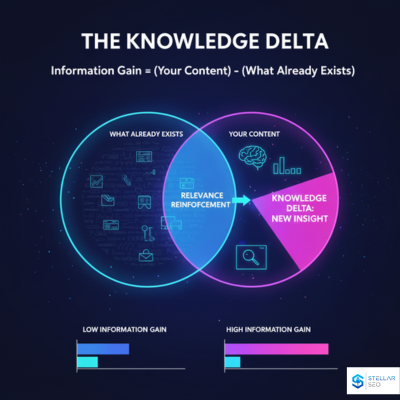
Information gain is easiest to understand when you think of it as a gap.
On one side is what the ecosystem already knows about a topic. This includes existing articles, studies, definitions, and widely accepted best practices. On the other side is what your content introduces. The distance between those two points is the Knowledge Delta.
A simple way to think about the Knowledge Delta is as a subtraction problem.
Information Gain = (Your Content) − (What Already Exists)
In practice, that means comparing your page to the top results already ranking for the topic. If your content covers the same ground, reaches the same conclusions, and introduces no new evidence or framing, the result is close to zero.
When the result is zero, ranking potential is capped. You can reinforce relevance and trust, but you are unlikely to shift perception or outperform established competitors. When the result is positive, the system has something new to learn, and authority can begin to compound.
When that gap is small, the contribution is incremental. The content reinforces relevance and helps confirm that a page belongs in a topic area, but it does not meaningfully change perception. When the gap is larger, the contribution is more substantive. The content adds understanding and begins to signal expertise rather than simple coverage.
This is also where link behavior starts to make more sense. Links do not create information gain on their own. They amplify whatever contribution already exists. A link pointing to content with a small Knowledge Delta reinforces relevance. A link pointing to content with a large Knowledge Delta reinforces expertise.
That is why some links feel stronger than others, even when the domains, anchor text, and metrics look similar. The surrounding information environment determines what the link actually reinforces.
How Information Gain Drives Link Earning
Links exist because one page adds value to another.
When content introduces new information, it gives publishers something they can actually use. Journalists cite it to support an argument. Industry sites reference it to explain a concept. Editors link to it because it saves them from repeating the same explanation themselves.
When content repeats what is already common knowledge, the dynamic changes. Outreach turns into negotiation. Links require incentives, relationships, or volume to achieve the same result. Over time, authority stalls because the content being promoted does not justify deeper reinforcement.
A simple example makes this clear.
Imagine fifty articles explaining what a backlink is. They might be accurate, well-written, and technically sound, but none of them will be cited because they add nothing new.
Now imagine one article that analyzes real backlink data and shows that roughly seventy percent of backlinks in the legal niche are nofollow, along with an explanation of why that pattern exists. That article becomes the reference point. Journalists writing about legal marketing cite it. Industry sites link to it. Other authors build on it.
This is why some sites acquire fewer links yet outperform competitors who build aggressively. The difference is not effort or scale. It is a contribution.
Information Gain and Semantic Link Building
Semantic link building is about reinforcing meaning, not just pointing at a URL.
The role of information gain is to determine whether that meaning is additive or redundant. When a link points to content that introduces nothing new, it reinforces relationships the system already understands. The link confirms relevance, but it does not expand the model of the topic.
When a link points to content with real information gain, the effect is different. The link helps introduce new relationships, new distinctions, or new ways of understanding how parts of a topic connect. Over time, those connections accumulate.
This is how meaning compounds instead of stagnating. Semantic links only become powerful when they are tied to new information rather than repeated narratives.
Information Gain and Entity-Based Link Building
Entity-based link building answers a different question than traditional outreach. It is not just about where a link points, but about who is being recognized as the source of knowledge.
When a brand is cited in connection with new insights, data, or frameworks, that association starts to stick. Search engines begin to connect the entity to the concepts being discussed. AI systems stop treating the brand as a summary of existing ideas and start treating it as a source.
As those citations repeat across independent sites, authorship and expertise signals strengthen. The brand becomes tied to the knowledge itself, not just the service being offered.
This is how entities transition from being seen as providers to being recognized as authorities.
Information Gain in AI Search and LLMs
AI systems prioritize sources that contribute original information for the same reason humans do. They need stable reference points.
Sources reduce the risk of hallucination by anchoring answers to verifiable facts and first-order analysis. When a model sees the same insight, dataset, or framework referenced across multiple independent sites, confidence increases. The system becomes more certain about both the information and the entity associated with it.
Over time, LLMs surface brands that consistently appear near novel insights rather than recycled explanations. These brands are not just relevant to a topic. They are treated as places where new understanding originates.
This is why original research, named frameworks, and proprietary terminology matter. They create identifiable reference points that the system can track, reinforce, and recall.
When Information Gain Matters Most
Information gain is not required for every website.
In less competitive markets, foundational SEO and standard link building are often enough to establish visibility and generate results. When the bar is low, relevance and trust carry most of the weight.
Information gain becomes critical when competition increases, and the basics are already in place. This is usually the point where link building continues, but progress slows. Rankings fluctuate, traffic stalls, and additional links fail to produce the same lift they once did.
At that stage, the problem is that repetition has reached its ceiling. To move forward, the site has to contribute something new, not just reinforce what is already known.
This is also where AI visibility and long-term authority start to matter. In advanced markets, the brands that continue to surface are the ones that add understanding rather than recycle it.
How This Fits Into an SEO Strategy
The difference between standard SEO and information-gain-driven SEO is not effort; it is intent.
| Standard SEO | Information Gain SEO |
| Summarizes existing knowledge | Contributes new understanding |
| Optimized for relevance | Optimized for expertise |
| Earns links through volume and outreach | Earns links through citation |
| Reinforces what the system already knows | Expands what the system understands |
| Effective in low to mid competition | Required in advanced markets |
| Authority must be constantly maintained | Authority compounds over time |
Information gain is not a replacement for foundational SEO or link building. It is the layer that explains why some strategies scale while others stall.
Foundational SEO establishes relevance. Quality link building campaigns build trust. Information gain is what turns that trust into expertise by giving the ecosystem something new to associate with your brand.
When these layers work together, authority compounds. Rankings become more stable, links carry more weight, and visibility is less dependent on constant volume or short-term tactics.
If your site is no longer advancing despite ongoing SEO and link building, the issue is often a lack of meaningful contribution.
This is where an information-gain-driven approach becomes the next step. By understanding how Google really ranks websites in 2026, you can build a strategy that lets you lead, not follow.
Related Resources