







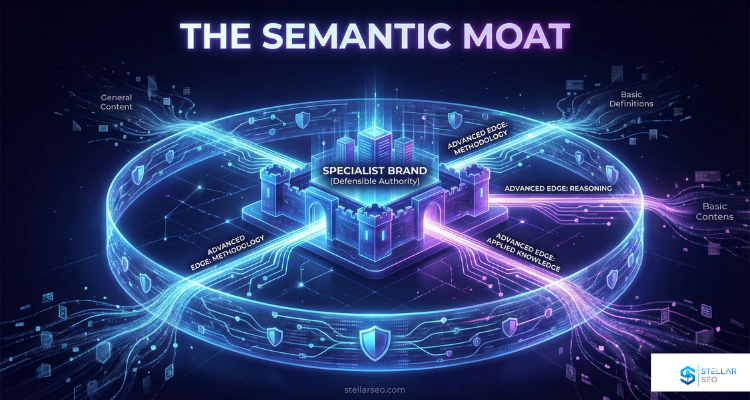
How the Knowledge Graph uses “Basic vs. Advanced Edges” to separate true experts from content mills.
Core Concept: The Semantic Moat is Stellar SEO’s proprietary SEO framework that builds defensible topical authority by creating “Advanced Edges” in the Knowledge Graph. While basic edges (definitions) group you with generalists, advanced edges (methodologies, frameworks, reasoning) classify you as a specialist, increasing visibility in AI Overviews.
AI search revealed a problem most brands never saw coming. Most companies assume that publishing more content increases visibility. In reality, volume does not equal authority.
Modern search systems classify companies based on the edges they form within the Knowledge Graph, and those edges reveal whether a brand is a true specialist or just another site that repeats common information.
Stellar SEO helps companies in YMYL and other competitive verticals build what we call The Semantic Moat, our unique framework that protects your brand from being grouped with generalists and positions you as a subject-level authority.
Basic edges tie your brand to broad concepts shared by countless others. They place you inside the category but do little to clarify your unique expertise. Advanced edges capture reasoning, methodology, and applied knowledge. They teach AI systems how your firm approaches problems, how you produce results, and why your perspective carries weight.
Brands shaped by basic edges end up grouped with generalist publishers and content mills. Brands defined by advanced edges gain separation. Their Semantic Moat strengthens identity, improves classification, and makes them more eligible for high-value visibility across AI-generated answers and competitive search environments.
How AI systems classify brands through entity relationships instead of keyword presence
Search engines and AI systems no longer determine rankings by counting keywords on a page. They classify brands by evaluating the relationships connected to an entity and the context surrounding those relationships. This shift defines how modern AI-driven search evaluates expertise. It explains why two sites covering the same topic can end up in entirely different parts of the Knowledge Graph.
AI evaluates how your brand connects to related ideas, organizations, processes, and concepts. These connections signal what you know, who you serve, and which problems you solve. In other words, you are ranked based on identity, not density.
A beginner piece introduces a surface-level concept. An advanced piece shows how that concept works in real conditions. When Google maps these deeper relationships, it classifies your brand as a practitioner instead of a commentator.
Brands that publish clear, topic-aligned material grounded in real-world logic gain an advantage because their edges reflect practical expertise, not surface familiarity. It also exposes “fluffy” writers. Their content exists in isolation, with no ties to the processes, decisions, or real-world conditions that define expert work.
To earn expert classification, your brand must give AI enough relational data to understand your identity. This is where the Semantic Moat begins. It shapes how AI systems interpret your identity, which edges they attach to your entity, and whether your brand gets placed among true experts or pushed into the generic content bucket.
Why the Knowledge Graph Relies on Edges to Decide Which Sources Demonstrate Subject-Level Expertise
The Knowledge Graph organizes information by mapping edges, the connections between entities, topics, actions, and attributes. These edges are how AI determines not only what you talk about, but what you actually know. A brand with shallow edges looks interchangeable with hundreds of others. A brand with deep, specific edges stands out as a subject-level authority.
Basic edges form when you publish introductory material, define terms, or cover broad concepts. Basic edges establish presence, not positioning. Every site in your niche produces the same type of beginner content, so the edges created by these pages are nearly identical.
Advanced edges are different. They form when you explain processes, reasoning, frameworks, decision factors, methodologies, risk considerations, or applied knowledge. These edges show how concepts relate to each other inside your domain and how they apply in real conditions. They reveal depth, not just familiarity.
The Knowledge Graph leans heavily on these advanced edges when deciding which sources demonstrate expertise. They help AI understand who leads the conversation, who performs the work, and who contributes original thinking rather than echoing common definitions. This is why two brands can publish the same number of pages, yet one is classified as a foundational reference while the other is treated as a specialist.
The more advanced edges you create, the clearer your identity becomes. This clarity influences how AI ranks your content, when it pulls you into answers, and how confidently it can cite your brand across precision queries. This is the beginning of a true Semantic Moat, and it determines whether your site competes as a leader or gets grouped with generalists.
The Dilution Effect: When Too Much Beginner Content Weakens Your Entity
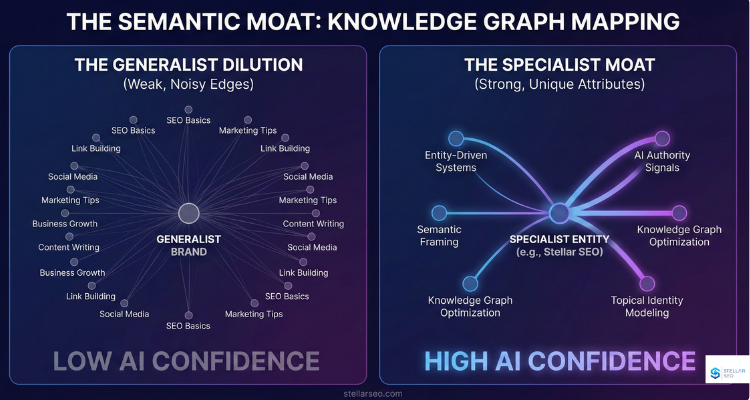
Most brands are trapped in the ‘Productivity Trap.’ They publish endless beginner articles, believing volume equals rankings. Instead, they are actively diluting their identity. This flood of basic material creates weak, generic edges that make your site look like a reference library rather than an authority. AI systems see the same patterns repeated by thousands of websites and classify you with them, placing you alongside generalist publishers.
Beginner content has its place. You need enough foundational material for AI to understand your category. But when basic edges dominate, the Knowledge Graph cannot distinguish your expertise from the low-quality AI content flooding the web.
The ratio is what matters. If 80 percent of your content is introductory, you are signaling to AI that you belong in the same bucket as high-volume generic publishers and low-level encyclopedic sites. The more you publish, the more you reinforce the wrong identity.
Advanced edges reverse that classification. When your content demonstrates reasoning, frameworks, applied methods, and deep subject understanding, AI recategorizes your brand as a specialist. These pages create the edges that competitors cannot fake. They stand apart from competitors and help systems understand that your expertise is real, actionable, and distinct from the generic material flooding search results.
How AI Evaluates Edge Density and Identity Strength
AI systems classify expertise by studying the density and distribution of the edges connected to your entity. Edge density refers to the number of meaningful relationships your brand forms within a topic. Identity strength reflects how clearly those edges point toward a specific area of specialization. The stronger and more concentrated your edges, the easier it is for AI to understand what you do and which judgment-heavy queries you deserve to appear for.
Your topical neighborhood forms when similar edges cluster together. If your site publishes material tied to litigation structure, causation reasoning, and complex liability frameworks, the system groups you inside the legal reasoning cluster. If your content covers vessel documentation, maritime depreciation, and lending risk factors, you fall inside the marine finance cluster. These clusters help the Knowledge Graph understand which conversations you belong to and which questions you are qualified to answer.
Unique or proprietary edges raise entity confidence because they demonstrate knowledge that generalist publishers cannot replicate. When you publish frameworks, real decision logic, internal methodologies, or applied problem-solving, you create edges that tie your brand to expertise rather than commentary. These edges increase certainty. The system sees not just that you talk about a topic, but that you understand how it works.
AI uses this distribution to separate specialists from generalists. A site with scattered beginner edges looks like an index of surface-level information. A site with deep, concentrated edges tied to advanced topics looks like a practitioner. Specialists earn higher rankings and win more opportunities to generate AI answers because their edge profile demonstrates depth, clarity, and authority. This is how the Semantic Moat becomes a competitive advantage.
Choosing the Right Advanced Edges for Your Brand
Advanced edges come from the parts of your work that reveal judgment, decision-making, and applied expertise. Every company has these signals, but most never publish them. AI systems treat these insights as proof of capability because they show how you think, not just what you know.
The first task is identifying the elements of your process that demonstrate real skill. These often include evaluation steps, diagnostic criteria, proprietary workflows, or methods your team relies on to deliver consistent outcomes. When documented, they become clear indicators of expertise that generic publishers cannot imitate.
The next step is shaping this internal knowledge into content that AI can map. This requires more than describing a topic. You surface the reasoning behind your choices, the variables you weigh, and the factors that influence outcomes. These details form the advanced edges that distinguish specialists from broad publishers.
The final move is turning complex industry challenges into public explanations that reinforce your authority. When you break down how a problem is assessed, which constraints matter, and how the right solution is chosen, AI gains a precise understanding of what your brand contributes to the field. This strengthens your identity, clarifies your topical footprint, and expands your eligibility for competitive queries that select only domain experts.
The Semantic Moat: Protecting Authority Through Advanced Edge Building
A strong edge profile creates separation that competitors cannot close with volume or surface-level posts. When your content produces edges tied to real methods, specialized decisions, or nuanced interpretations, AI treats those signals as proof of expertise. This builds a Semantic Moat that protects your position, even as others flood the web with generic material.
These advanced edges stabilize rankings by anchoring your brand to concepts that require genuine knowledge to explain. AI systems rely on these connections when choosing which sources to elevate in competitive environments. Brands with deeper, more detailed edges gain preference because their insights reduce uncertainty during classification.
Most agencies cannot replicate this type of content. They produce summaries, rewrites, and keyword-guided explainers that never reveal how an expert thinks. Without access to real processes or domain judgment, they cannot generate the edges that define high-authority entities. This gives you a defensible advantage. Competitors may match your publishing volume, but they cannot match your substance.
Stellar SEO builds campaigns around this principle. Every advanced edge becomes part of a long-term identity framework that compounds over time. The result is a brand that AI can classify with confidence and elevate with intent.
Industry Examples of Advanced Edge Mapping
AI classifies expertise by comparing the edges your content creates to the edges everyone else produces. Each industry has common beginner material that forms basic edges and a much smaller set of advanced, reasoning-based edges that only true practitioners can produce. Below are streamlined examples that clearly show the difference.
Law
Most firms publish basic edges such as definitions of negligence, explanations of filing deadlines, or overviews of injury case types. These pages tell AI you operate in the legal category, but they do not show legal reasoning.
Advanced edges come from material that explains how attorneys establish breach using facts, how causation is challenged in complex cases, how damages are modeled during negotiation, or how firms evaluate litigation strategy. These edges map the thinking behind the work and place the brand inside the litigation reasoning graph rather than next to general legal explainers. Stellar SEO uses this strategy when developing personal injury lawyer and mass tort SEO campaigns to give our clients a clear advantage.
Marine and Marine Finance
Basic marine SEO content covers what a yacht loan is, or the types of marine insurance available. This establishes the category but not the expertise.
Advanced edges form when you explain how depreciation schedules differ by vessel class, how surveys affect underwriting decisions, how USCG documentation shapes lien recording, or how compliance factors influence borrower qualification. These edges demonstrate operational, financial, and regulatory depth, positioning the brand within the specialized marine finance ecosystem.
Finance
Basic financial edges revolve around definitions of APR, credit scores, or common loan types. Every financial publisher covers these topics, so they produce no differentiation.
Advanced edges emerge from content that breaks down how lenders weigh repayment probability, how regulatory rules shape underwriting logic, how lenders model collateral strength under variable market conditions, or how fraud vectors are assessed. These edges reveal professional decision-making, signaling to AI that the brand operates within the financial reasoning graph rather than at the surface-level consumer finance level.
Why This Contrast Matters
When a brand produces mostly basic edges, AI groups it with reference sites and generalist publishers. When a brand produces advanced edges, AI places it in the expert neighborhood where source selection, AI Overview visibility, and competitive rankings happen. Our Semantic Moat helps you avoid being lumped in with generalists.
How Advanced Edges Improve AI Overviews and Answer Engine Visibility
Advanced edges provide AI with the clues it needs to determine what your brand should be cited for. When your content demonstrates reasoning, frameworks, and applied knowledge, the system can place you inside the correct topic cluster and trust you with more specific, higher-value queries. These edges also have a greater influence during LLM training because they show how concepts interact, not just what they mean.
Clear, well-defined edges signal that your brand is a stable authority. As your edge graph deepens, you become eligible for queries that require judgment, interpretation, or specialized workflows. Generalist sites rarely qualify for this tier. Brands with advanced edges earn placement because the model can connect their identity to the real logic behind the search intent.
How Semantic Link Building Reinforces Advanced Edges
Advanced content attracts stronger links because publishers covering meaningful topics seek sources that contribute depth, not definitions. When your insights appear inside context-aligned articles, the surrounding language frames your expertise in a way AI can map. This amplification does not happen on broad, unfocused sites. It comes from placements where the topic and the framing match the advanced edges you produce.
Semantic link building strengthens this effect by securing placements that reinforce the identity you want AI to recognize. Each link becomes a semantic support beam. Instead of random mentions, you get edge-aligned reinforcement that teaches the Knowledge Graph how to categorize your brand with clarity and confidence.
Positioning Your Brand for the Next Era of AI SEO
Expert-level content will outperform generalist content across all AI systems as ranking shifts from keyword matching to expertise mapping. Brands with deeper edge graphs outrank larger publishers because AI favors clarity over volume. When your entity sends strong, consistent signals, you gain ranking stability, broader query eligibility, and more frequent inclusion in AI answers.
This is the long-term advantage of building a Knowledge Graph footprint rooted in advanced expertise. Competitors can copy topics. They cannot copy the edges you create when you explain how your work is done, how decisions are made, and how outcomes are achieved.
Build an Expert-Level Knowledge Graph Footprint
Stellar SEO uses the Entity Driven Link Building System (EDLS) to deliver the off-page semantic reinforcement that AI systems reward. EDLS strengthens the identity you build on your site by placing links in contexts that match your advanced edges and clarify how your brand fits into the Knowledge Graph.
Your on-site content creates the expertise signals. EDLS amplifies those signals across the web, turning them into clear, mappable authority that AI systems can understand and trust.
If you want an AI SEO strategy, that wasn’t built for last decade’s algorithm, schedule a strategy call. We will map the edges your brand is missing and design a plan to strengthen your brand identity, improve visibility, and build lasting authority in your market.
Related Resources
AI SEO & Identity Clarity
Authority & Link Signal Frameworks
- Entity-Driven Link Building System
- Consistency Across Social Media Builds SEO Authority and AI Discovery
- Brand Mentions as Identity Signals