








The Reality of Link Building for Boat Dealers and Brokers
For boat dealers and yacht brokers, link building is not an abstract SEO exercise. It is a reputation system that directly influences rankings, lead quality, and revenue.
When executed correctly, a link building campaign supports three outcomes that matter commercially for a dealership or brokerage. In a typical SEO campaign, 60-70% of the total boat dealer SEO budget is allocated for earning these powerful validation signals.
Rankings and Revenue
High-quality backlinks remain the strongest external signal Google uses to determine whether an inventory page, such as “2025 Schaefer 400 Sport for sale,” deserves to rank above aggregators like YachtWorld or BoatTrader. Higher rankings translate into direct organic traffic and qualified leads without platform commissions.
Referral Traffic from High-Intent Buyers
Links function as demand channels. A placement on a marine publication, an enthusiast forum such as The Hull Truth, or a local boating guide sends buyers who are already researching ownership, performance, and lifestyle. These visitors convert at a higher rate than generic marketplace traffic.
Entity Reinforcement for AI Search and the Knowledge Graph
In AI-driven search environments, including Google, Gemini, ChatGPT, and Perplexity, links act as citations. They define who you are, where you operate, and which manufacturers you are authorized to represent. This entity validation increasingly determines visibility in AI-generated answers.
The most valuable links reinforce more than one of these signals at the same time. A manufacturer’s “Find a Dealer” link, for example, strengthens entity trust while driving qualified referral traffic. That is the standard effective marine link building aims for.
The YachtWorld Problem and the Role of Authority
Most dealers syndicate inventory to YachtWorld, BoatTrader, and Boats.com. They pay recurring fees, supply the data, and still lose visibility into the platforms that republish their listings.
Search results for queries such as “Cigarette 38 Top Gun for sale” are typically dominated by aggregators. The reason is straightforward. These platforms have millions of backlinks and a strong domain authority.
Volume cannot be matched. Specificity can.
Google prefers to rank the source over a directory when sufficient authority exists. A focused link building strategy signals that the dealer’s page is the canonical version of the listing and deserves precedence.
This is where disciplined, entity-aligned link acquisition becomes non-negotiable.
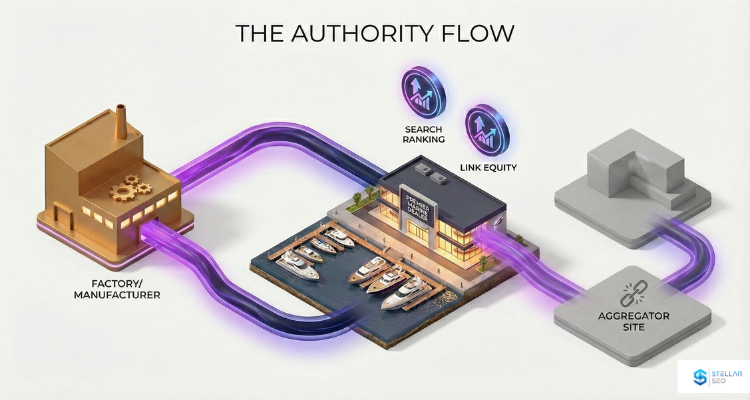
Manufacturer Authority and Authorized Dealer Signals
Dealers already possess one of the strongest link opportunities in the marine industry through manufacturer relationships.
Brands such as Sea Ray, Schaefer, Viking, and Yamaha operate highly authoritative websites and routinely publish dealer locator or “Find a Dealer” pages. In many cases, these listings are underutilized.
Common issues include:
- Plain-text listings with no link
- Nofollow links that pass no authority
- Homepage links instead of brand-specific destinations
The correction is straightforward. Dealers should work directly with factory representatives or manufacturer marketing teams to secure dofollow links pointing to manufacturer-specific landing pages.
Weak: yourdealer.com
Strong: yourdealer.com/new-boats/schaefer-yachts/
This concentrates authority on pages that compete for brand-level searches and reinforces authorized dealer status within Google’s entity graph.
The Broker’s Edge: Personal Authority and Sold-Market Signals
For yacht brokers and independent agents
Authorized dealers benefit from manufacturer authority. Independent yacht brokers operate under a different dynamic.
In brokerage, the broker is the entity.
There is no factory website passing link equity. No dealer locator reinforces relevance. Visibility depends on whether search engines recognize the broker as a market authority, not just a listing intermediary.
For brokers, link building is not limited to ranking a specific hull number. It determines whether your personal brand surfaces when sellers search for representation or when buyers look for market expertise.
Queries such as “best yacht broker in Fort Lauderdale” or “who sells the most Viking sportfish yachts” are entity-driven searches. Winning them requires authority signals attached directly to the broker, not just inventory.
Market Intelligence as a Link Asset
Dealers sell specifications. Brokers sell judgment.
The most linkable asset for a yacht broker is not a listing, which expires, but market intelligence that persists.
Publishing periodic market analysis positions the broker as an analyst rather than a salesperson. Examples include quarterly or annual reports focused on narrow segments, such as late-model sportfish, flybridge motoryachts, or express cruisers.
A report titled “The State of the 2018–2022 Sportfish Market: Asking Prices vs. Closed Sales” provides data that financial blogs, luxury publications, and marine trade outlets routinely cite.
When that data is referenced, links point back to the broker’s site as the source. Over time, this teaches search engines that the broker is an authority on a specific asset class, not just a participant in transactions.
Sold Listings as Permanent Proof of Performance
Most brokers remove listings once a yacht sells. From a search and authority perspective, this is a missed opportunity.
A sold yacht page is permanent proof of execution.
Instead of deleting listings, brokers should convert them into “Sold” case studies that document the outcome. A page titled “2015 Azimut 80 Sold in 14 Days” can outline pricing strategy, presentation decisions, buyer sourcing, and final results.
These pages attract links naturally when shared with sellers evaluating representation. They also signal to search engines that the broker facilitates completed transactions, not just listings.
Over time, a growing archive of sold case studies reinforces the broker as an active market operator with demonstrable results.
Authority Transfer Through Media and Commentary
In the high-end market, buyers and sellers evaluate the broker as closely as the yacht.
Podcast appearances, industry interviews, and guest commentary transfer authority directly to the broker’s personal entity. Marine podcasts and luxury lifestyle shows routinely publish show notes with links to guest profiles. These links carry high topical relevance and point directly to the broker, not a generic listing page.
Similarly, contributing columns to adjacent industries expands authority beyond marine-only audiences. Topics such as yacht ownership tax considerations, asset depreciation, or cross-border transactions are frequently covered by wealth management and financial publications.
Links from these sources elevate the broker’s profile page and, by extension, every listing associated with that name. This creates an authority halo effect that benefits current inventory and future listings alike.
Experience-Based Assets and Enthusiast Authority
Manufacturer photography and stock descriptions are interchangeable. They do not earn links.
First-hand experience does.
In the marine industry, raw walkthroughs, delivery runs, refits, and sea trials consistently attract attention from serious buyers and enthusiast communities. These assets answer questions that aggregators cannot.
Effective executions include:
- Refits of used performance boats
- Delivery trips documenting ride quality and handling
- Sea trials conducted in real conditions
Distribution matters as much as production. Sharing this content inside established communities such as The Hull Truth, OffshoreOnly, and SeriousOffshore generates contextual links and sustained referral traffic. The content is positioned as a resource, not a sales pitch.
These links are durable because they are earned through experience, not placement.
Event-Driven and Geographic Authority Signals
Boat shows, poker runs, regattas, and tournaments create consistent opportunities for geographically relevant backlinks.
Examples include:
- Exhibitor profiles for FLIBS, MIBS, and Palm Beach that include dofollow links
- Sponsor listings for poker runs and performance boating events
- Local tourism or chamber “Things to Do” and boating guides
These links reinforce regional relevance and associate the dealership or brokerage with recognized marine institutions. They support both local visibility and inventory-level rankings.
Technical Defense: Protecting Authority in a Syndicated Market
Link acquisition only compounds value if your site is recognized as the authoritative source.
Publishing manufacturer or marketplace descriptions verbatim undermines that authority. Aggregators are often indexed first, which causes dealer pages using identical language to be filtered as duplicates.
Every meaningful listing should follow the Broker’s Take standard.
That means 300 to 500 words of original dealer commentary that goes beyond specifications and explains ownership, usage, and performance in real-world terms. Combined with proper canonical configuration, this ensures authority flows to the dealer site rather than reinforcing platforms.
Turning Raw Specifications Into Information Gain and Visual Authority
To understand the difference between a basic listing and an authority page, consider a specific example, the Pursuit S 388 Sport.
A manufacturer’s spec sheet presents raw data:
- LOA: 41′ 1″
- Beam: 12′ 0″
- Fuel: 500 gallons
- Deadrise: 22°
- Engines: Triple Yamaha 450 XTOs
Most dealers repeat this table verbatim. That content adds no value. Google and AI systems already have access to these specifications. Repeating them does not improve rankings or visibility.
Authority is built by converting specifications into scenarios.
Translating Specifications Into Buyer-Relevant Insight
Search engines and AI systems reward novelty and explanation. The goal is not to restate the spec, but to explain why it matters.
| Raw Specification | Dealer-Level Information Gain |
| 500-gallon fuel capacity | Range and routing implications: At an efficient cruise with Triple 450 XTOs, the S 388 supports a Miami to Bimini run, extended offshore fishing, and a return to Government Cut without refueling. For buyers concerned about fuel quality and availability in the islands, this removes a common operational constraint present in many boats in this class. |
| 12′ 0″ beam | Stability under load: Pursuit maintains a full 12-foot beam rather than narrowing the hull for top-end speed. In 3 to 4 foot chop, this wider footprint reduces snap roll and improves lateral stability, making the platform suitable for bottom fishing and family use, not just high-speed runs. |
| Triple Yamaha 450 XTOs | Low-speed control and torque: The choice of 450s is about more than peak speed. The XTOs deliver low-end torque that keeps the boat on plane at approximately 18 mph when fully loaded with fuel, ice, and passengers. This matters in slow-speed and manatee zones common in South Florida, where stern drag becomes a real handling issue. |
This type of explanation creates information that does not exist (called information gain) on manufacturer pages or listing platforms. It positions the dealer as the source of operational knowledge, not just as a source of inventory access.
This is also how pages surface for queries such as “Is the Pursuit S 388 stable for fishing” or “Can a Pursuit 388 run to Bimini without refueling,” questions that raw spec sheets cannot answer.
Visual Engine Optimization and Proof-Based Media
Manufacturer photography is designed for marketing. Boats are empty, conditions are ideal, and nothing is tested.
Visual Engine Optimization (VEO) documents real use, real conditions, and real outcomes. Images and video demonstrate how a boat behaves in operation, not just how it looks at rest.
Search engines and AI systems evaluate visual content using the same principles applied to text. Context, specificity, and evidence determine value. Visual assets that demonstrate performance carry more weight than stock imagery reused across multiple dealer sites.
A Practical Example
Many listings include a clean photo of an empty livewell.
A stronger approach uses a short vertical video showing the livewell in operation, circulating live bait under load.
Alt text example:
“Pursuit S 388 36-gallon livewell pressurization test with live bait.”
This single asset communicates flow rate, capacity, and offshore suitability in a way static photography cannot. It also introduces original visual information that does not exist on manufacturer or marketplace pages.
Why VEO Strengthens Local Authority
Boat purchases are inherently local. Buyers search for inventory they can inspect, sea trial, and service nearby.
VEO reinforces local relevance by documenting boats in local waters, at recognizable marinas, and under regional operating conditions. A sea trial filmed in Biscayne Bay, Tampa Bay, or Lake Michigan provides geographic context that manufacturer content cannot supply.
When paired with location-aware captions, alt text, and surrounding page context, VEO strengthens dealer-level signals tied to place, inventory, and real-world operation. This supports both local rankings and AI-driven discovery for location-specific searches.
VEO functions as proof. Dealers who consistently publish real-world visual documentation outperform those relying solely on generic marketing assets.
VEO as an Image Link Building Asset
High-quality, original visual assets create link opportunities that standard listings do not.
Publishers, forums, local boating guides, and marine publications regularly embed images and videos to support their content. When those assets are unique, contextual, and correctly attributed, they earn image-based backlinks to the dealer’s site.
VEO content supports image link building by providing:
- Original visuals unavailable on manufacturer or marketplace sites
- Clear contextual relevance for editorial use
- Natural attribution opportunities through embedded images and video
Over time, these image-based links compound authority while reinforcing the same entity and local signals that drive inventory rankings. This makes VEO a dual-purpose asset, strengthening both on-page authority and off-page link acquisition.
Why This Content Wins in Search and AI Results
AI-driven search systems prioritize context, explanation, and novelty. When a user asks, “Show me the fishing layout of the Pursuit S 388,” pages that document real usage and performance surface more often than marketing assets or spec tables.
This is how a dealer page becomes the answer, not just another listing.
Where EDLS Fits Into Marine Link Building
At Stellar SEO, marine link building is executed through our Entity-Driven Link System (EDLS).
EDLS focuses on acquiring links that reinforce:
- Manufacturer relationships
- Inventory specificity
- Geographic relevance
- Entity trust across search and AI systems
Rather than chasing link volume, EDLS prioritizes placements that simultaneously compound rankings, referral traffic, and entity authority. This approach mirrors how Google ranks websites in 2026 and is how dealers reduce platform dependency and reclaim control over visibility.
Visibility Follows Authority
Listing inventory leaves you vulnerable. Dealers who want margin control and long-term visibility must own authority.
Effective link building in the marine industry requires platform awareness, manufacturer alignment, and precision execution. Generic SEO tactics fail because they ignore how marine buyers actually research.
Stellar SEO builds entity-driven link strategies designed to rank inventory, reinforce dealer credibility, and reduce platform dependency.
If you want your inventory in front of buyers instead of buried beneath platforms, contact us for a custom Marine link building strategy.