








Why Search Blended Our Brand When Search “Stellar SEO Reviews Reddit”
Most people assume search results reflect reality. They type in a business name, read a few summaries, skim Reddit, and accept the information as accurate.
That confidence fades once a search system treats a token like a brand or blends unrelated discussions because certain words appear close together. Modern AI summaries push this even further, often merging signals from multiple sources without a full understanding of context.
Our team frequently monitors branded search volatility. During one of these checks, we spotted a pattern that highlights how easily systems blend language.
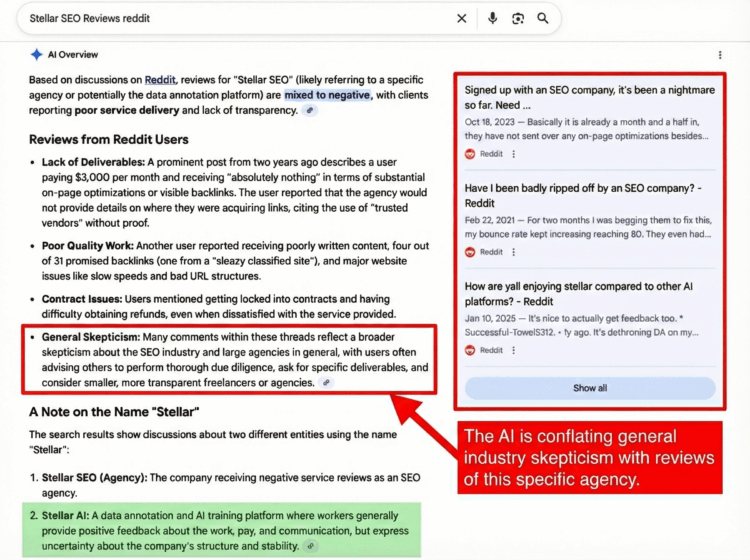
A search for “Stellar SEO reviews Reddit” returned threads about a different company with “stellar” in its product name. It also surfaced comments where people used the phrase “less than stellar results” to describe unrelated SEO experiences.
None of the content referenced our agency, yet it still appeared under a branded query. Because “stellar” is a dictionary word used millions of times per month, even strong entity signals cannot fully prevent occasional blending. That makes our brand an ideal stress test for understanding how modern search systems behave.
The cause traces back to how search systems interpret language, especially when tokens, entities, and co-occurrence overlap unpredictably.
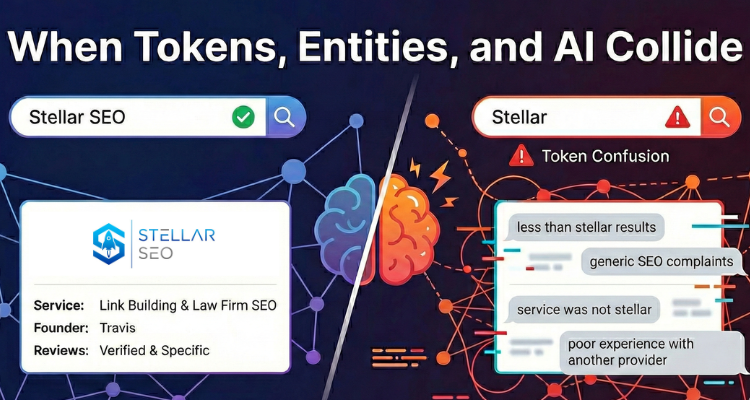
Token vs Entity Confusion
- A token functions as a plain piece of text.
- An entity represents a specific business, person, or location.
Some names fall into both buckets. “Stellar” is used in everyday language as both a compliment and a criticism. It also serves as our brand identifier. When a system encounters a word without strong contextual clues, mixing occurs. Brands with dictionary words in their names often face the same challenge.
Anyone working on AI search visibility should understand this foundation. Our AI SEO Services explain how language models process tokens and attempt to map them to entities.
Co-Occurrence Drives the Grouping
Co-occurrence refers to how often certain words appear near each other. Search systems use proximity patterns to infer meaning.
Consider a post like:
“I had less than stellar results with my SEO provider.”
The tokens “stellar,” “results,” and “SEO” sit close together. A model connecting those tokens might then associate the conversation with searches for:
- Stellar SEO reviews
• Stellar SEO Reddit
• Stellar SEO Reddit reviews
The writer never mentioned our brand, but the co-occurrence pattern encouraged the system to combine them.
This same mechanism influences how platforms like ChatGPT, Gemini, and Perplexity form their answers. For more details on this pattern, see our guide on LLM-optimized content.
AI Summaries Push the Blending Further
AI answer engines depend heavily on token patterns and entity recognition. Weak or unclear signals encourage the model to guess. When it guesses wrong, the result can distort a brand’s reputation.
Forced Entity Matching Clears the Confusion
Our team tested one more variable to confirm what caused the mixed results. When the search used quotation marks around the brand name, the outcome changed immediately.
A search for “stellar seo” reddit returned accurate information. The summary recognized the agency correctly, highlighted real feedback, and displayed results related to our brand instead of unrelated commentary.

Quotation marks force the system to treat the phrase as a single unit. The model reads “Stellar SEO” as a fixed identity rather than two separate tokens. That small change prevents the system from blending our brand with unrelated posts that use the word “stellar” in a casual or descriptive way.
Without quotes, the system often sees “stellar” as an adjective and “SEO” as a topic. That pattern encourages the blending seen in searches like “Stellar SEO reviews Reddit” and “Stellar SEO Reddit reviews.” With quotes, the intended entity becomes clear, and the correct information rises to the surface.
This test confirms something important. The reputation data exists in the index. The search model simply failed to retrieve it because of token overlap and co-occurrence. Once the identity is locked, the confusion disappears.
You cannot expect potential clients to use quotation marks to reveal accurate information. The search engine needs to recognize the firm without extra steps. Strong entity alignment prevents this type of mix and establishes clarity across both search and AI platforms.
Frequently Asked Questions
Why do unrelated reviews appear when searching for “Stellar SEO”?
Search platforms sometimes group discussions together when a brand name overlaps with common language. The word “stellar” appears in phrases like “stellar results” or “stellar service,” so threads using those expressions may be grouped with searches for our company. A separate software company called “Stellar AI” contributes to the overlap as well. We track these patterns regularly to ensure proper brand separation.
What is the difference between a Token and an Entity?
A token functions as a plain piece of text. An entity represents a specific business, person, or organization. Confusion arises when a model treats a brand name as a simple token rather than a distinct organization. Strong entity signals prevent these mix ups.
What is Co-Occurrence in SEO?
Co-occurrence refers to how often two terms appear near each other. When a firm’s name regularly appears with accurate legal terminology, AI systems learn the proper associations. When the name appears near unrelated or negative language, confusion becomes more likely.