






“How long do backlinks take to work?” is one of the most common questions in link building, and it remains one of the most misunderstood concepts in search.
The short answer is this: most high-quality backlinks take several weeks to influence search engine rankings, and meaningful SEO results from a link building campaign are measured in months, not days.
After a Backlink Is Indexed, It Takes 6–12 Weeks to Take Effect
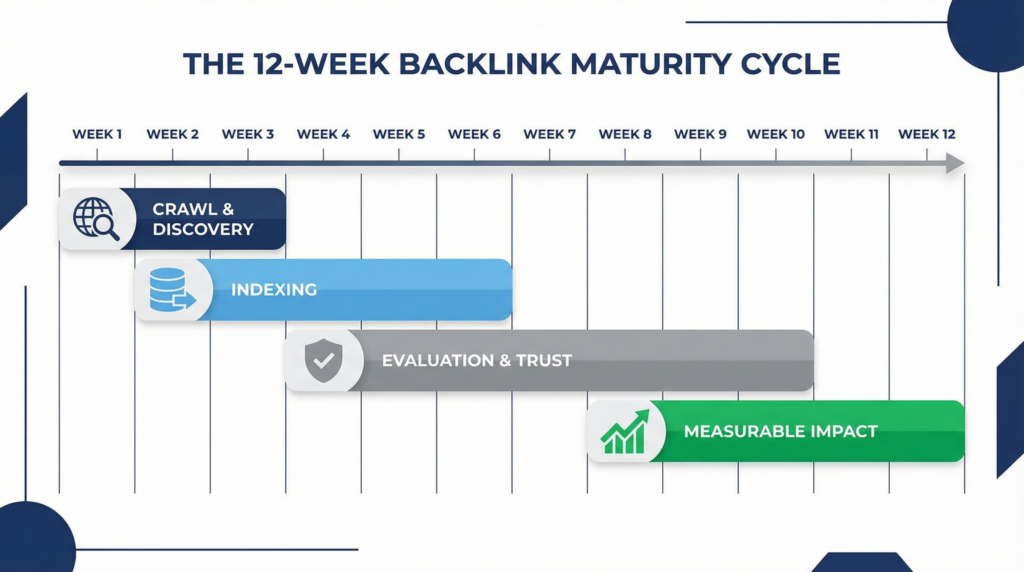
From our internal data across legal, finance, and competitive service industries, a new backlink typically begins contributing measurable SEO value within 6 to 12 weeks, once it has been discovered, crawled, indexed, and evaluated by Google’s systems.
In some cases, movement appears in as little as a few weeks. In others, especially in competitive SERPs, it takes longer. Our link building agency has built over 25,000 links in the past decade, and the insights below are based on that real-world data.
Timelines vary because not all links carry the same authority, relevance, or trust.
For a backlink to work, Google must first crawl the linking page, index the backlink, and evaluate the authority, relevance, and link profile of the referring page. Only then is link equity attributed to the target page and weighed against competing pages and other ranking factors. Until that process completes, a backlink exists but does not meaningfully influence Google search results.
This is why tools like Google Search Console and Google Analytics often show a delay between when a link is built and when search traffic or search rankings change. A backlink can exist without yet providing SEO value.
How Long Does an Individual Backlink Take to Work?
For a single high-quality backlink placed on a relevant, authoritative site, the typical timeline unfolds in stages. Google usually crawls the linking page within the first few weeks, indexes the backlink shortly after, and begins applying SEO value within roughly 4 to 12 weeks as page authority and rankings adjust.
Links from high-domain-authority sites, authoritative publications, and digital PR placements often move faster because Google crawls those pages more frequently. Links from low-quality sites, blog comments, or thin web pages may be crawled slowly or ignored entirely.
A nofollow link can still indirectly contribute to backlink effectiveness, primarily through referral traffic and discovery, but it will not pass traditional link equity the way a followed link does.
Anchor text also matters. Relevant anchor text helps Google understand the relationship between the linking page and the target page, while over-optimized or spammy anchor text can delay or suppress impact.
Why “Backlinks Taking Effect” Is Not Instant
Google search is a trust-and-validation system, not a real-time voting system.
When a new backlink is discovered, Google does not immediately assign ranking credit. Instead, the link is evaluated in context. Google looks at the authority of the referring page, the overall domain authority and site authority of the linking site, the relevance of the linking page to the target page, and where the link appears within the content. It also considers how that link fits into the site’s broader link profile and link velocity.
Only after those signals are assessed does link equity begin flowing in a meaningful way.
This is why a single new link rarely pushes a page to the first page on its own, especially in competitive search results. Backlinks work best when they reinforce other SEO signals, including internal linking, content quality, and sustained link-building efforts.
Focusing on getting more links without regard to link quality, relevance, or domain authority often leads to stalled SEO results. In those cases, backlinks exist, but they do not meaningfully change how search engines evaluate the page.
How Long Does Link Building Take to Show Results?
While an individual backlink can take several weeks to work, link building as a system operates on a longer timeline. Search engines do not evaluate backlinks in isolation. They evaluate link-building efforts collectively across all the pages on your website.
In most competitive markets, a properly executed link-building campaign begins producing visible SEO results within 3 to 6 months, with more substantial and more consistent gains appearing between 6 and 12 months. This is the point at which cumulative link equity, page authority, and site authority begin to set your site apart from competitors.
This delay is how Google search prevents manipulation.
Why Backlinks Work Better in Groups Than Alone
Backlinks are a compounding signal. Each new link does more than pass isolated link equity. It reinforces credibility at multiple levels, including the linking page, the target page, and the surrounding internal link structure.
When several quality backlinks point to the same target page, Google gains confidence that the content deserves to rank, that reputable sites support it, and that the page can realistically compete in search engine rankings. This confidence does not come from any single link, but from the pattern those links create over time.
That is why multiple backlinks from relevant sites often outperform a single link from a high authority domain, even when that domain has a strong domain authority score. Consistency and relevance matter more than one-off authority.
As links accumulate, Google becomes more efficient at distributing link juice across the site. Pages supported by internal linking benefit from this flow, allowing authority to spread to related pages rather than remaining isolated on a single URL.
Typical Timelines for a Link Building Campaign
Based on internal data from SEO campaigns across law, finance, and national service brands, realistic timelines look like this:
- Month 1-2: Backlinks are acquired, crawled, and indexed
- Month 3-4: Early ranking movement for secondary keywords
- Month 6: Primary pages begin climbing in Google rankings
- Month 7-12: First page visibility stabilizes for core terms
Industries with lower competition may see results faster. Highly competitive search results, such as legal or financial SEO, take longer due to higher authority thresholds.
Link Velocity and Search Engine Trust
Link velocity, the rate at which new backlinks are earned, plays a critical role in how quickly backlinks take effect.
Search engines expect natural growth. A sudden spike in inbound links without corresponding content quality, digital PR, or brand signals can slow progress or suppress gains. Consistent link-building efforts signal legitimacy and long-term intent.
This is one reason why structured SEO campaigns outperform short-term link blasts.
Measuring Progress with Google Search Console and Google Analytics
In the early stages of a link-building strategy, Google Search Console is more reliable than Google Analytics for measuring progress.
Search Console reflects how Google Search responds to your link-building efforts. As backlinks are discovered and processed, you will see new backlinks indexed, additional referring pages recognized, and gradual increases in impressions across Google search results. These signals appear before rankings fully stabilize.
Google Analytics usually lags because it measures search traffic rather than authority. Traffic increases only after ranking improvements hold long enough to drive consistent clicks. This delay often leads site owners to assume backlinks are not working when, in reality, the links are still being evaluated.
Understanding the difference between Search Console and Google Analytics helps prevent premature conclusions and keeps link-building campaigns aligned with how search engines actually operate.
Your Starting Point Affects How Long Backlinks Take to Work
Search engines no longer evaluate backlinks strictly as isolated ranking signals. They use links to validate entities inside Google’s Knowledge Graph.
When backlinks point to your website, Google evaluates the link equity alongside the existing trust and authority associated with your brand entity. A backlink works faster when it reinforces an existing entity that Google already understands.
Knowledge Graph Validation Changes Backlink Timelines
Sites that are clearly defined entities inside Google’s systems benefit from faster backlink effectiveness.
When a site shows consistent brand signals across authoritative sites, maintains a clear topical focus across all pages, earns repeated mentions from relevant high authority domains, and has a stable link profile without manipulation, Google interprets new backlinks as confirmation rather than exploration.
Because the entity already exists with high confidence, Google’s index updates more quickly, and link equity is applied more efficiently.
For newer or fragmented sites, backlinks trigger a discovery phase. Google must crawl and index the links, then observe how other authoritative sites reference the same entity over time before assigning full SEO value. Until that pattern is established, backlink effectiveness is delayed, even when the links themselves are high-quality.
Why LLMs Care About the Same Signals
Large language models that power Google AI Overviews, ChatGPT, and other AI-driven search systems rely on the same trust signals.
LLMs favor entities that are:
- Repeatedly referenced by authoritative sites
- Consistently described across the web
- Supported by high-quality links from reputable sources
This means backlink effectiveness now extends beyond traditional rankings and helps determine whether your site is citable, quotable, and eligible for AI-driven visibility.
A link from an authoritative site boosts your page’s ranking in SERPs and strengthens your entity footprint across search engines and AI systems.
Backlinks as Entity Signals, Not Just Ranking Factors
This is why two sites with similar backlinks can see very different outcomes.
One site gains search rankings and AI visibility quickly because its backlinks reinforce a trusted, well-defined entity. The other struggles because Google and large language models are still determining what the site represents and whether it should be trusted.
From a modern SEO perspective, backlinks work best when they support a clearly defined entity, reinforce topical authority, align with content quality and internal linking, and appear naturally across authoritative sites. When those conditions are met, backlinks accelerate trust rather than merely adding raw link counts.
Spammy links, unrelated guest posts, and artificial link velocity do more harm than good for the same reason. Instead of strengthening authority, they send conflicting signals that slow trust accumulation and reduce the effectiveness of backlinks.
What This Means for Link Building Strategy in 2026
In 2026, effective link building is about earning links that confirm your site as a trusted entity inside Google search, Google’s Knowledge Graph, and AI-driven discovery systems.
That is how backlinks work faster. That is how SEO results compound. And that is how authority becomes defensible.
Why Backlinks Work Faster for Trusted Entities (Amazon vs a New Site)
To understand how long backlinks take to work, you have to understand entity trust.
Search engines do not treat Amazon as just a website. Amazon is a fully established entity inside Google’s Knowledge Graph. Its relationships to products, brands, categories, authors, and commerce are deeply mapped and continuously reinforced by authoritative sites.
As a result, backlinks pointing to Amazon behave differently.
Amazon’s Entity and Authority Advantage
When Amazon publishes a new product page, that page immediately inherits high domain authority, strong sitewide link equity, a trusted Knowledge Graph entity, and extensive internal linking from authoritative pages.
As a result, fewer backlinks are required, and those backlinks take effect faster. Google bots crawl Amazon constantly. New links are indexed quickly. Link juice flows efficiently to the target page.
In practical terms, a single high-quality backlink to an Amazon product page can influence search rankings in weeks, not months, even if competing pages have more links at the page level.
This is not because the link is stronger, but because the entity receiving the link is already trusted.
Why New or Niche Sites Take Longer
Now compare that to a new niche website selling handmade products.
Even when that site earns quality backlinks from reputable sites, Google still has work to do. It must determine what the site represents, whether it is a legitimate business, how it relates to other entities in its space, and whether links pointing to it appear consistently over time.
For this type of site, backlinks trigger entity discovery rather than confirmation. Google crawls the linking page, indexes the backlink, and then observes how frequently and how consistently other authoritative sites reference the same entity.
Because that validation process takes time, backlinks to a new site often take several months to influence search engine rankings materially.
How This Impacts AI and LLM Visibility
LLMs surface entities they recognize, trust, and see repeatedly validated across authoritative sources. Amazon qualifies immediately. A new site does not.
This means backlinks now do double duty. They influence Google search rankings while simultaneously validating entities for AI-powered search, summaries, and answer generation.
Sites with weak or unclear entity signals may build links and even see modest ranking improvements, yet still struggle to appear in AI-generated results. Without consistent entity validation, backlinks contribute limited visibility beyond traditional SERPs.
The Takeaway for SEO Strategy
Backlinks work faster when they reinforce an entity Google already trusts. They work more slowly when Google is still deciding who you are.
This is why effective link-building campaigns must align with a clear topical focus across all pages, strong internal linking, consistent brand and entity mentions, and high-quality backlinks from relevant sites. When those elements work together, backlinks accelerate trust and compound SEO value.
Without that alignment, backlinks still work, but timelines stretch, authority accumulates more slowly, and ROI suffers.
FAQs
How Long Do Backlinks Take to Work?
Most backlinks take several weeks to begin influencing search engine rankings, with measurable impact typically appearing within 6 to 12 weeks after the link is discovered and indexed. In competitive industries, backlinks work faster when they reinforce an existing trusted entity rather than introducing a new one.
When Do Backlinks Start to Take Effect?
Backlinks start to take effect only after Google bots crawl the linking page and Google’s index processes the link. A backlink can exist without providing SEO value until Google evaluates its relevance, authority, and relationship to the target page.
Why Do High-Quality Backlinks Work Faster?
High-quality backlinks come from authoritative, relevant sites that Google already trusts. These links are crawled more frequently, indexed faster, and pass more substantial link equity. They also reinforce entity trust, which improves backlink effectiveness across both traditional search and AI-driven systems.
How Does Domain Authority Affect Backlink Timelines?
Domain authority determines how efficiently link equity flows through a site. High-domain-authority sites convert new backlinks into ranking gains faster because Google already trusts the domain. Low authority sites require repeated validation before backlinks fully influence search results.
How Long Does It Take for Backlinks to Be Indexed?
Links from low-quality or thin pages may take longer to be indexed, or may never be indexed at all. Faster backlink indexing usually correlates with more substantial SEO value.
Does Anchor Text Affect Backlink Effectiveness?
Yes. Anchor text helps Google understand the relationship between the linking page and the target page. Relevant, natural anchor text improves link relevance, while over-optimized or spammy anchor text can reduce trust and slow ranking improvements.
What Role Does Google’s Index Play in Backlink Value?
Google’s index is where backlinks are evaluated and weighted. Until a link is fully processed in Google’s index, it does not contribute to rankings. This evaluation phase explains why backlinks work gradually rather than instantly.
How Does Digital PR Improve Backlink Effectiveness?
Digital PR earns backlinks from authoritative publications that Google and LLMs treat as trusted sources. These links strengthen entity recognition, improve backlink effectiveness, and increase eligibility for AI-generated search visibility.
Why Do Some Backlinks Work Better Than Others?
Backlink effectiveness depends on link quality, relevance, placement, and the authority of the referring page. Not all links pass the same SEO value. A single contextual link from a reputable site often outperforms dozens of low-quality links.