







Executive Summary
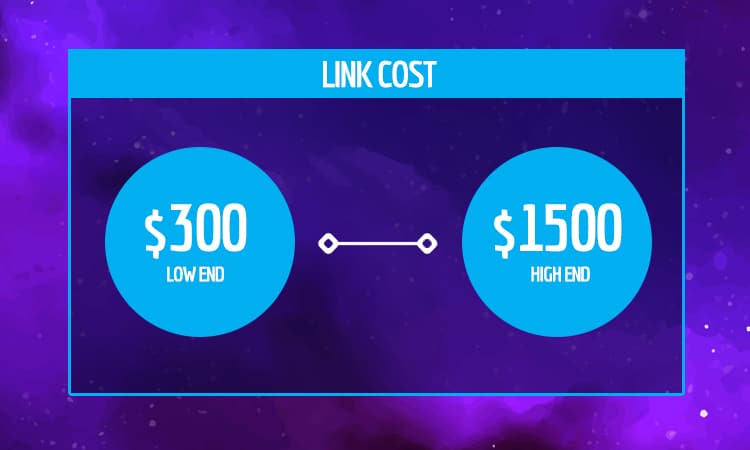
Link building typically costs $5,000 to $10,000 per month, or $300 to $750 per link. Your actual link building costs vary based on how many links you need and what level of authority is required to compete.
Your current link and authority levels, both on a page and a sitewide basis, as well as your competitive landscape, directly impact cost and timeline.
Even with the right type of links in the right volume, a flawed strategy can cause link costs to skyrocket while producing poor ROI.
Partnering with link building experts like Stellar SEO ensures you acquire the right links, in the right volume, backed by a strategy aligned to competition and outcomes.
How Much Do Links Cost in 2026?
There is no single price for a backlink that applies across all industries or goals.
At a practical level, most brands fall into one of two pricing models:
- Per-link pricing, most commonly used for guest posts, niche edits, and editorial placements where the buyer manages strategy internally.
- Managed link building campaigns, where monthly pricing reflects the time, expertise, and coordination required to plan, execute, and adjust an ongoing outreach program.
The right model depends on how competitive your market is, how strong your existing backlink profile is, and whether you already have a clearly defined link building strategy.
To set realistic expectations, the sections below anchor both models to independent market data before outlining how Stellar SEO prices link building campaigns.
Link Building Pricing Summary
Before reviewing any link building agency pricing, it helps to anchor expectations to independent industry data. Multiple third-party studies examining real paid placements and outreach campaigns consistently land within the same pricing ranges.
Average Price Ranges and Typical Campaign Budgets
Average cost per link: ~$350 to $500
Ahrefs analyzed sponsored posts and backlink purchases and found that the average paid backlink costs approximately $361 per link, excluding labor and outreach costs. Siege Media, a leading content marketing and digital PR agency, has stated that a sustainable long-term cost per earned link typically lands around $500 once content creation and outreach effort are included.
Digital PR links: ~$750 to $1,500+
Siege Media and Authority Hacker both show that editorial placements on high-authority publications through digital PR campaigns routinely exceed $750 per placement. Costs increase as publication authority rises and as stories require original research, proprietary data, or journalist review.
Managed link building campaigns: ~$3,000 to $15,000+ per month
Agencies such as Page One Power and uSERP publicly list monthly retainers that begin in the low four figures and scale into five figures for competitive industries. These budgets reflect ongoing strategy, prospecting, content creation, outreach campaigns, and placement management, not just raw link acquisition.
These benchmarks reflect editorial links on reputable sites with real organic traffic, not automated placements, private networks, or low quality links sold at scale.
Link Building Pricing Scale in 2026
Link building pricing ranges widely because the effort required to close a competitive authority gap varies from site to site. Cost is not driven by link type alone, but by how much authority a page needs to gain in order to compete.
At the low end, pricing reflects one-off placements with minimal editorial review and limited relevance. These links may work in low-competition environments, but rarely move rankings where stronger competitors are already established. In the middle range, pricing supports controlled per-link execution where quality standards are enforced and links are mapped to specific pages.
At the high end, pricing reflects managed outreach campaigns in competitive markets, where earning links requires research, content creation, relationship building, and precise editorial alignment.
This ties directly back to link building ROI. If a page requires a meaningful authority lift to compete, under-investing leads to wasted spend. If the strategy is misaligned with the competitive landscape, even high-quality links can produce poor results. The right pricing tier is the one that closes the authority gap between your page and the sites already ranking above you.
Evaluating building cost without first understanding that gap almost always leads to inflated link costs and disappointing returns.
Link Building Packages Pricing
Many businesses search for link building packages pricing because they want a clear sense of what a realistic investment looks like before engaging an agency. While effective link building is never one-size-fits-all, most campaigns naturally fall into predictable pricing tiers based on competition, authority gaps, and execution requirements.
Typical Investment Tiers
The packages below reflect typical investment ranges, not fixed deliverables. Link volume varies based on link type, authority requirements, and placement difficulty. Outcomes, not link counts, are what ultimately matter.
Starter / Foundation Link Building Package
Typical investment: $2,500–$3,500 per month
This tier is best suited for lower-competition markets, newer sites building initial authority, or brands that already have a defined SEO strategy and need consistent execution.
Common use cases include:
- Supporting existing authority with targeted guest posts
- Strengthening secondary pages or content assets
- Filling small competitive link gaps
This range works when authority gaps are modest, and rankings can move with focused, high-quality placements rather than aggressive volume.
Growth Link Building Package
Typical investment: $5,000–$7,500 per month
This is the most common pricing range for companies actively competing for commercial keywords and service pages.
Growth-level packages typically support:
- Editorial guest posts on reputable, relevant sites
- A mix of mid- to higher-authority link placements
- Ongoing outreach aligned to priority pages
This tier is appropriate when competition is real, authority gaps exist, and rankings require sustained effort rather than isolated placements.
Authority / Enterprise Link Building Package
Typical investment: $10,000+ per month
This tier is required in highly competitive or regulated industries where authority thresholds are high and editorial standards are strict.
Authority-level packages are commonly used in:
- Personal finance, legal SEO, SaaS, and national service markets
- Situations where competitors have deep, established backlink profiles
- Campaigns that require higher-authority links, digital PR placements, or advanced outreach
At this level, pricing reflects the effort required to earn links that materially shift rankings in difficult environments.
How to Interpret Package Pricing
Link building packages are best viewed as effort and authority tiers, not bundles of guaranteed links.
The right package is the one that closes the authority gap between your pages and the competitors already ranking, while still making sense from an ROI perspective. Stellar SEO Link Building Pricing Model
We structure link building pricing around the same market realities outlined above. Cost is aligned to competition, authority gaps, and execution complexity, not arbitrary link counts. Our pricing models are designed to support different levels of strategic involvement, depending on your internal resources and goals.
Per-Link Pricing
Per-link pricing is best suited for teams that already have a defined SEO strategy and need reliable execution.
This model works well when you already know:
- Which pages are you building links to
- How anchor text should be handled
- How links fit into your broader backlink profile
Pricing under this model includes:
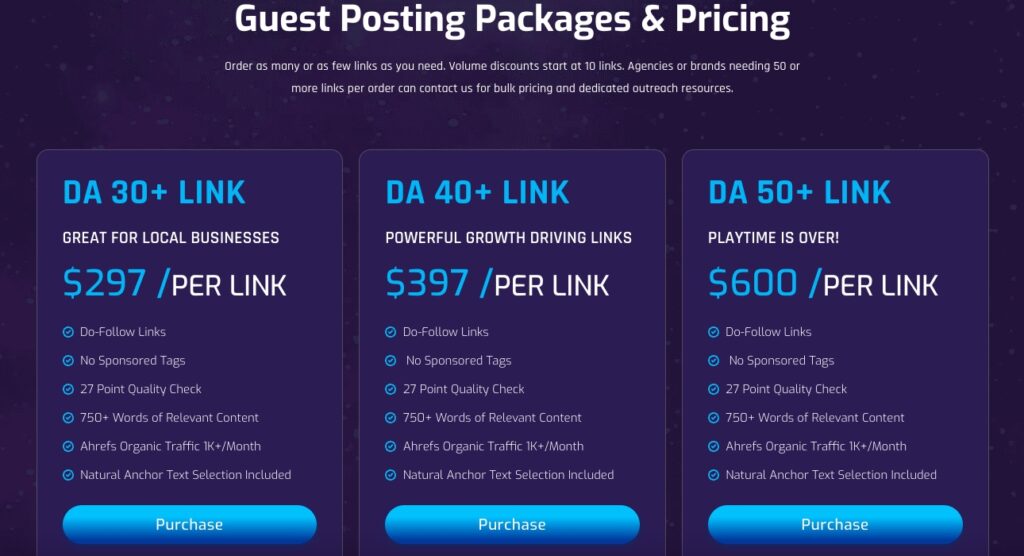
- Guest posts and blogger outreach: $297 to $600 per link
- Niche edits: $225 per link
Pricing varies based on domain rating, domain authority, organic traffic, editorial standards, topical relevance, and placement quality. Links are placed on reputable sites with real traffic and editorial oversight, not mass-published networks.
Per-link pricing is commonly used by agencies, in-house SEO teams, and experienced brands that want predictable unit costs while retaining full control over strategy, targeting, and pacing.
Custom Link Building Campaigns (Managed Outreach)
Custom link building campaigns are designed for competitive environments where strategy, placement control, and authority growth matter more than raw link volume.
This model is best suited for brands that:
- Operate in competitive or regulated industries
- Need links to specific service pages or high-value assets
- Require oversight into the process or a detailed approval process
Typical investment levels include:
- Starting campaigns: $2,500 per month
- Most active campaigns: approximately $5,000 per month
- Enterprise and high-competition campaigns: $10,000+ per month
Custom campaigns include link building strategy, competitive analysis, prospecting, content creation, outreach campaigns, publisher coordination, quality assurance, reporting, and ongoing optimization. Pricing reflects the effort required to earn links that materially improve rankings, not just increase link counts.
This model is most commonly used in verticals such as personal finance, legal SEO, SaaS, and national service markets, where high authority links and editorial standards are required to compete.
Per-Link Pricing vs Managed Campaigns
Choosing the right pricing model matters more than chasing the lowest average price. The wrong structure often leads to misaligned execution, wasted spend, or stalled rankings, even when link quality is technically acceptable.
Which Model Fits Your Needs?
Per-link pricing is a strong fit when execution is the missing piece, not strategy. This is most commonly used by other SEO agencies and experienced in-house teams that already have a defined link building strategy and need a scalable fulfillment layer. White label guest posting and niche edits work well in this scenario because they integrate cleanly into an existing roadmap, scale predictably, and support campaigns that have already been planned and approved.
This model is also effective when pacing, budget control, and unit economics matter more than experimentation or strategic iteration.
Managed link building campaigns are a better fit when strategy, prioritization, and guidance are required, not just placements. Brands without a dedicated SEO team, organizations entering a competitive market for the first time, or companies operating in complex or regulated industries benefit from having strategy, execution, and adjustment handled together.
In these cases, managed campaigns allow Stellar SEO to guide page selection, anchor strategy, outreach tactics, and quality control in a coordinated way. Agency costs reflect the work required to earn links that actually move search rankings, not just add to a backlink count.
The right model is the one that matches your internal capabilities and removes the biggest bottleneck between your site and the rankings you are trying to achieve.
DR and DA–Based Pricing Models Explained
Many link building vendors price links based on domain rating (DR) or domain authority (DA) ranges because these metrics provide a fast way to screen websites at scale. On the surface, this approach feels objective and easy to compare.
However, DR and DA are third-party metrics, not ranking factors. They do not guarantee editorial standards, organic traffic quality, topical relevance, or ranking impact. High scores can be inflated through expired domains, redirected link equity, or aggressive internal linking. At the same time, lower-metric sites can represent strong opportunities when relevance, context, and editorial placement are right.
This is where many link buyers run into problems. A common example is being sold a DR 70 link on a site with little to no organic traffic, excessive outbound links, and no topical alignment. Despite the impressive metric, these placements often produce little to no movement because the site carries minimal real authority where it matters.
At Stellar SEO, DR and DA are only one data point in a broader evaluation process. Every site we consider is reviewed against a 27-point screening criteria that includes organic traffic patterns, topical relevance, editorial standards, outbound link behavior, placement context, and how the link reinforces the semantic and entity signals of the target page.
In modern link building, authority is not just about strength, but about alignment. Links that support the correct topical and entity relationships help search engines better understand what a page represents and where it belongs in the competitive landscape. Metrics help narrow the field, but performance comes from relevance, context, and editorial trust.
Used correctly, DR and DA help filter opportunities. Used incorrectly, they are how brands end up paying premium prices for links that look impressive on paper but fail to move rankings.
Why Link Building Prices Vary So Much
Link building prices vary because the difficulty of earning editorial trust varies. Regardless of pricing model, several factors consistently influence link cost, and each one directly affects effort, timelines, and results.
Editorial standards matter. Authoritative websites enforce stricter review processes and higher content expectations. Earning placement on sites with real editorial oversight requires stronger ideas, better writing, and more back-and-forth, all of which increase cost.
Content creation matters. Link-worthy content improves outreach success rates and placement quality, but it also adds production time and resources. Campaigns built around original insights, data, or strong narratives cost more to execute, but convert at a higher rate.
Industry competition matters. Highly competitive and regulated industries such as finance, legal, and insurance command higher link costs because publishers are more selective and opportunities are limited. In these markets, links are harder to earn and easier to price aggressively.
Outreach difficulty matters. Sites with consistent organic traffic and clean backlink profiles receive more pitches and reject more requests. The higher the demand for placement, the more effort is required to secure approval.
Creative flexibility matters. Brands with strict messaging, legal review, or approval layers limit outreach angles and content formats. These constraints reduce placement options and increase the time required to earn each link.
Brand strength matters. Recognizable brands tend to earn links more easily than unknown entities. Established trust improves response rates, while newer or lesser-known brands require more effort to validate credibility during outreach.
When pricing falls far below established benchmarks, it typically signals low-quality links, weak editorial review, inflated metrics, or sites built primarily to sell placements. In competitive environments, these shortcuts rarely produce measurable ranking gains and often increase long-term costs by forcing campaigns to be rebuilt later.
Be Warned: Link Farms and Artificially Cheap Links
Many vendors selling one-time links, such as guest posts, operate networks of sites that exist only to publish paid content. These are commonly referred to as link farms.
If someone offers a DA 70 link for $100, the site is almost certainly worthless from a ranking perspective.
Buying links without vetting reputable sites, traffic patterns, and editorial standards is how backlink profiles become bloated and ineffective.
In-House vs Agency Link Building Costs
Many companies assume that once link building budgets grow, moving in-house becomes the logical next step. In reality, the highest-performing programs rarely choose one or the other. They use agencies as the execution engine and internal teams for direction and prioritization.
The True Cost of Building In-House at Scale
| Cost Factor | Building In-House | Partnering with Stellar SEO |
| Staffing | $150k+ (Salary + Benefits) | Included in Retainer |
| Tools | $6k – $12k / year | Included |
| Turnover Risk | High (Campaigns stop if staff leave) | None (Redundant team capacity) |
| Ramp-Up Time | 3-6 Months | Immediate |
| Flexibility | Low (Fixed Headcount) | High (Scale up/down monthly) |
| Total Year 1 Cost | ~$200,000+ | ~$60,000 – $120,000 |
Running link building internally requires more than headcount. It requires systems, redundancy, and continuity, especially at higher volumes.
A functional in-house operation typically includes:
- A senior SEO or link strategist to own direction and quality control
- Multiple specialists for prospecting, outreach, and follow-up
- Ongoing content production capacity
- A full outreach and research tool stack
- Email deliverability infrastructure and monitoring
Fully loaded, this commonly exceeds $200,000+ per year, before accounting for ramp-up time, turnover, or stalled production during transitions. Even then, output is tightly coupled to individual performance. When people leave, campaigns slow or stop.
At higher volumes, the challenge is not cost alone, but operational fragility.
Why Large Buyers Still Rely on Agencies
Established link building agencies solve problems that become more pronounced as budgets increase.
Agencies provide:
- Redundant outreach capacity that does not disappear with turnover
- Existing publisher relationships across multiple verticals
- Proven quality controls and vetting processes
- Immediate scalability without hiring delays
- The ability to shift strategy quickly as rankings, competitors, or priorities change
For large buyers, agency spend is not about saving money per link. It is about reducing execution risk while maintaining velocity and quality.
In practice, many enterprise teams use agencies like Stellar SEO as their primary acquisition layer, while internal teams focus on:
- Page prioritization
- Anchor strategy
- Performance analysis
- ROI modeling and budget allocation
The Cost Reality at Higher Spend Levels
At scale, the question shifts from “What is cheaper?” to “What is more reliable?”
Agency-led campaigns typically deliver:
- Faster time to first impact
- More consistent link velocity
- Lower operational risk
- Easier budget scaling up or down
This is why even companies capable of building in-house often continue working with specialized agencies. The cost difference narrows at scale, while the risk-adjusted return favors experienced execution.
The Strategic Takeaway
In-house teams make sense for oversight and long-term ownership. Agencies make sense for execution, scale, and consistency.
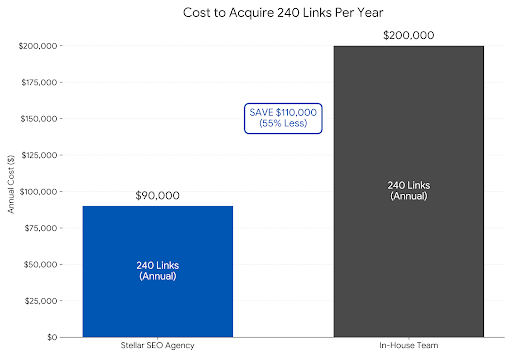
For buyers investing heavily in SEO, the most effective model is rarely replacing an agency. It is partnering with one that can operate as an extension of the team, align with competitive goals, and absorb the operational complexity that slows internal programs down.
How Industry Affects Link Building Pricing
Industry has a direct impact on link building pricing because it influences both publisher behavior and client-side requirements. In practice, costs rise for two different reasons, and understanding the difference helps set realistic expectations.
The first factor is publisher pricing power. In certain industries, site owners know that links carry high commercial value and price placements accordingly. Casino, gambling, loans, and personal finance sites are prime examples. Publishers in these spaces are frequently approached by well-funded companies and affiliates, which drives up placement costs regardless of link quality. Even moderate-authority sites in these industries often charge premium rates simply because demand is high and free linking is rare.
The second factor is client-side oversight and standards. Industries such as legal, financial services, healthcare, and regulated SaaS often require stricter compliance, messaging review, and placement controls. These constraints reduce the number of viable placement opportunities and increase the time required to earn each link. In many cases, the cost is driven less by publisher fees and more by the effort needed to meet internal review standards and quality expectations.
In addition, some industries carry higher link quality requirements by necessity. Clients operating in competitive or sensitive markets often expect tighter editorial control, stronger topical relevance, and higher-authority placements. Those standards naturally increase the cost per placement, even when publishers are not charging aggressively.
By contrast, content-friendly niches such as education, hobbies, charities, and lifestyle topics generally support lower link costs when value-driven, informational content is used. Publishers in these spaces are more willing to link organically, and editorial barriers are lower.
Industry-driven pricing is not arbitrary. It reflects the combined reality of market demand, editorial resistance, compliance expectations, and competitive pressure, all of which must be accounted for when building a sustainable link building strategy.
How Many Links Do You Actually Need?
There is no universal number of links that guarantees results. The number of links required is determined by competition and authority gaps, not preference or arbitrary benchmarks.
In many cases, a smaller number of high quality backlinks from authoritative websites outperform large volumes of weaker links. Effective link building efforts focus on closing specific competitive gaps rather than accumulating links for their own sake.
At Stellar SEO, link volume is determined through page-level and domain-level competitive link gap analysis. We evaluate the backlink profiles of the pages and domains currently ranking above you, identify where authority deficits exist, and map link acquisition to the level required to compete. This approach ensures that link building efforts are aligned with ranking thresholds, not guesswork.
By anchoring link strategy to real competitive data, brands avoid overbuilding, underinvesting, and wasting budget on links that do not materially improve search engine rankings. The goal is not to build more links, but to build the right links to close the gap that matters most.
Return on Investment: Budgeting for Link Building
Link building is an essential pillar of SEO, but it is also a significant investment. Planning matters more than per-link pricing, especially in competitive markets.
At Stellar SEO, we evaluate each priority page individually and estimate what it will take for that page to rank. This includes identifying the number of links required, the types of links needed (editorial, guest posts, digital PR links, high authority placements), and the authority gap between your page and the competitors currently ranking.
From there, we tie link requirements directly to cost and traffic potential. By estimating the investment required to reach competitive parity or exceed it, we can model whether the expected organic traffic and conversion value justify the spend. This allows clients to make informed decisions based on ROI, not assumptions.
Budgets are built around the pages that drive revenue, the authority required to compete, and realistic timelines for impact. If the numbers make sense, we proceed with a strategy aligned to rankings and growth. If they do not, we adjust scope, targets, or priorities before any links are built.
Brands that treat link building as a strategic investment with precise cost-to-outcome alignment consistently outperform those that treat it as a commodity purchase. The goal is not to build links blindly, but to invest where rankings and revenue justify the effort.
See our link building ROI guide on Search Engine Land for a deeper look into this.
Independent Research on Link Building Costs (Expanded)
Independent research consistently reinforces the same pricing reality: editorial links cost what effort, competition, and authority demand, not what vendors advertise on rate cards.
Across multiple industry studies, the data clusters tightly once quality, labor, and editorial standards are accounted for.
Baseline cost per link: ~$350 to $600
Ahrefs reports an average paid backlink cost of approximately $361 when purchasing placements directly from site owners, excluding labor and outreach time. BuzzStream’s 2025 pricing analysis supports this range, finding that higher-quality sites with meaningful organic traffic and stronger editorial standards average $609 per link when filtered for quality.
uSERP’s 2024–2025 State of Link Building Report further validates this range, showing that companies are willing to pay an average of $508.95 per high-quality backlink when working with agencies. Siege Media similarly cites ~$500 per earned link as a sustainable long-term average once content creation and outreach efforts are included.
Digital PR and premium authority links: ~$1,000 to $1,500+
When links require original research, journalist outreach, or placement on high-authority publications, costs rise significantly. BuzzStream, uSERP, and Credo all show digital PR links routinely exceeding $1,000 per placement, with many landing in the $1,250 to $1,500+ range depending on publication authority and editorial complexity.
Credo’s SEO pricing survey explains why. At average industry rates of $100 to $150 per hour, and with outreach success rates often below 10%, it commonly takes 5 to 10 hours of human effort to earn a single high-quality editorial link. Once labor is accounted for, true “earned” links naturally fall into the four-figure range.
Industry and quality premiums
AWISEE’s 2025 benchmarks add another layer of context, noting that U.S. placements on sites in the DR 50–70 range typically cost $300 to $600, while DR 70–90 placements range from $600 to $1,500+. They also document 50–100% pricing premiums in high-scrutiny verticals such as legal, finance, SaaS, and regulated industries due to stricter editorial standards and limited linking behavior.
Taken together, these studies all point to the same conclusion. Once traffic quality, editorial review, labor, and competition are factored in, the real cost of links converges, regardless of who publishes the data.
These figures reflect editorial links earned through real outreach and content placement, not automated networks, bulk guest post farms, or low-quality links sold at scale.
What a Fair Price for Link Building Really Means
A fair price for link building reflects the effort required to earn editorial trust, not a metric score or a promised quantity of links.
Cheap links remove the work that produces results. Effective link building pricing aligns cost with competition, quality, and outcomes, ensuring links strengthen authority rather than inflate a backlink count.
The right budget is the one that produces measurable movement on the pages that matter most, not the one that buys the most links on paper.
If you want clarity before committing spend, request a link building cost breakdown. We evaluate your pages, identify the authority gap, estimate the types and volume of links required to compete, and tie that investment to traffic and revenue potential.
The right strategy paired with the right links produces ROI. That will always outperform cheap links.